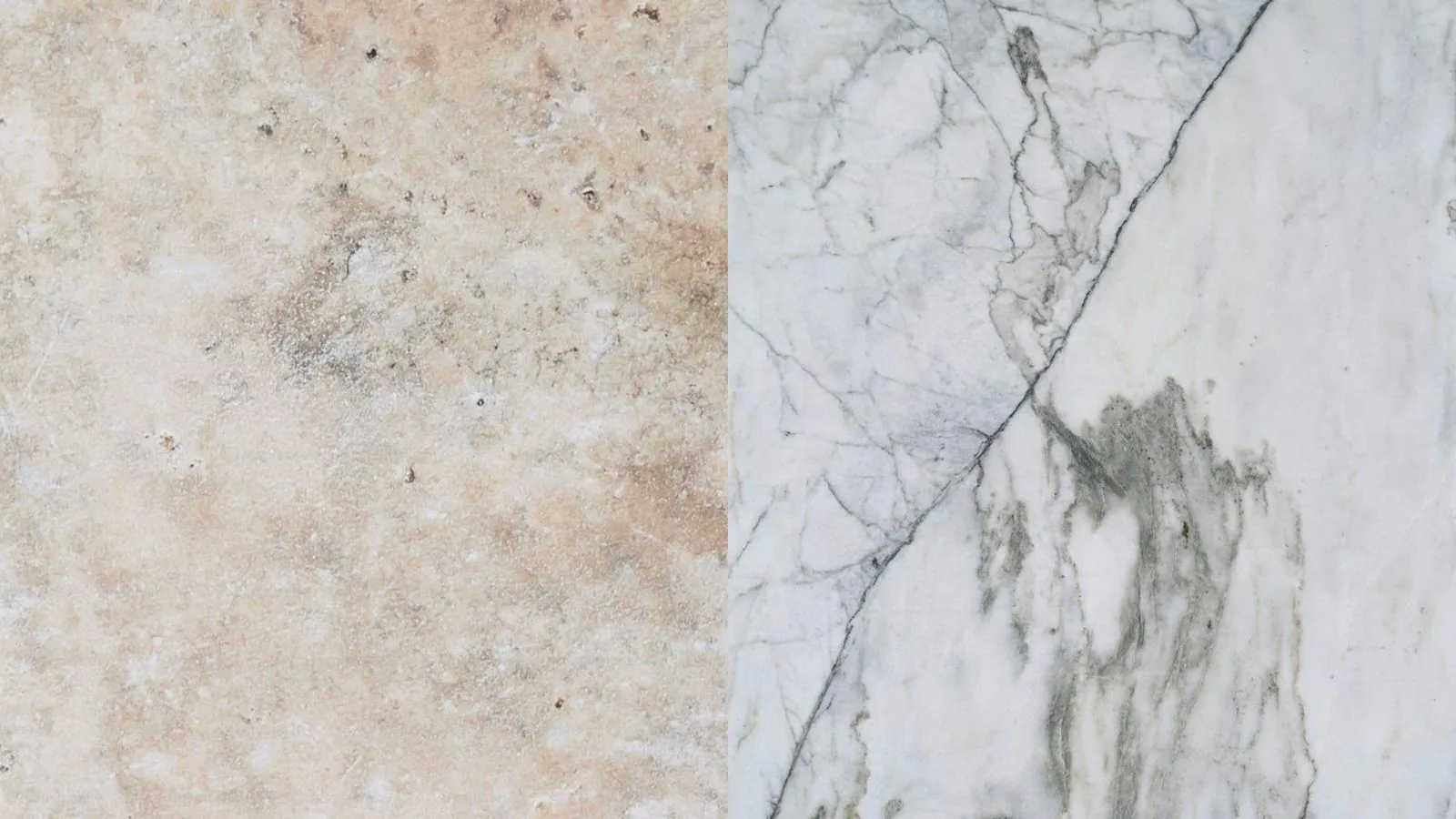
Marble and travertine are often compared as if the choice were about colour. It is not — they form differently, wear differently, and age along different lines.
Marble and travertine are often shown side by side and described as if the choice were mainly about colour. It is not. They are formed differently, they behave differently in a room, and they age along different lines. One of them records your life on its surface more readily than the other.
This guide sets out where they genuinely differ, where the difference is overstated, and how to decide which belongs in a particular piece of furniture.
What Is the Actual Difference Between Marble and Travertine?
Both are calcium carbonate stones, which is why they share a family resemblance in how they are cut, finished and cared for. The difference is in how they formed.
Marble is limestone that was buried, heated and compressed until its crystals recrystallised. That process is what produces the density, the translucency at the edges, and the veining — the veins are mineral impurities that were folded through the stone under pressure.
Travertine formed at the surface rather than under it, deposited by mineral springs. Water carrying dissolved calcium carbonate laid the stone down in layers, and gas escaping through those layers left small voids behind. Those voids — the characteristic pitting — are travertine's signature.
Is Travertine a Type of Marble?
No, although the two are frequently conflated in retail listings. Travertine is a sedimentary stone; marble is metamorphic. In practice this means travertine is generally softer, more porous and more textured, while marble is denser and takes a higher polish.
How Do They Look Different in a Room?
Marble is a stone of contrast. A Calacatta Viola or a Rosso Levanto has a base colour interrupted by veins that read as drawing — sharp, directional, high-contrast. Marble asks to be looked at.
Travertine is a stone of texture. Its palette runs through creams, warm greys, soft golds and pale browns, banded rather than veined. The variation happens across the surface in gentle horizontal layers rather than in dramatic lines.
The practical consequence: a marble piece tends to become the focal point of a room, while a travertine piece tends to settle into it. If your room already has strong art, patterned textiles or figured timber, travertine will coexist where marble may compete.
Which Photographs Better?
Marble, almost always — which is worth knowing, because it means online photography systematically flatters marble over travertine. Travertine's appeal is tactile: the shallow pitting catches light in a way a photograph flattens. People who see both in person frequently prefer the travertine they had dismissed on screen.
Which Is More Durable?
Marble is harder and denser, so it resists scratching and abrasion better. Travertine is softer and will show wear sooner on surfaces that are used roughly.
But durability is the wrong frame for both. Neither stone is a laminate. Both are porous, both react to acid, and both will change over a lifetime of use. The question worth asking is not which lasts longer — both outlast the room they are in — but which kind of change you are comfortable seeing.
What Does "Reacting to Acid" Actually Mean?
Calcium carbonate dissolves in acid. Lemon juice, wine, vinegar, tomato, carbonated drinks and many household cleaners will etch the surface if left on it, leaving a dull mark where the polish has been removed.
This is not staining. A stain is something absorbed into the stone; an etch is a change to the surface itself. The two are often confused and are treated differently. Sealing helps against staining; it does not prevent etching.
Which One Stains More Easily?
Travertine, because it is more porous. Its voids and open structure give liquids more places to enter. An unsealed travertine surface will take up oil more readily than an unsealed marble one.
That said, this difference narrows considerably once both are sealed and maintained. A sealed travertine table in a household that wipes spills is not a fragile object.
Where travertine has an advantage: its warm, mottled palette disguises small marks far better than a pale marble does. A ring on white marble announces itself. The same ring on travertine often disappears into the stone's own variation.
Do Travertine's Holes Need to Be Filled?
This is the question people ask most, and the answer depends on the piece rather than on the stone.
Filled travertine has its voids packed with a matching resin or cement before finishing, producing a surface that is continuous and easy to wipe clean. It is the practical choice for tables and any horizontal surface that will hold a glass.
Unfilled travertine keeps its voids open, which is more honest to the material and considerably more tactile. It is better suited to vertical surfaces and to pieces where the texture is the point.
For furniture that will be used daily — a coffee table, a dining table, a desk — filled is almost always the right decision. Crumbs and liquid in open voids are a maintenance problem that never resolves itself.
Which Is Better for a Coffee Table?
Coffee tables take glasses, books, feet and children. They are handled constantly and cleaned casually.
Travertine forgives this better. Its texture and warm variation absorb the small marks of use, and a honed finish disguises them further. Marble on a coffee table looks extraordinary and will collect a visible history — which some people love and others find stressful.
If you want a piece that will look the same in five years, choose travertine with a filled, honed surface. If you want a piece that becomes a record of the room, choose marble and accept the terms. Our guide on choosing a coffee table size works through the dimensions once the material is settled.
And for a Dining Table?
The same logic applies with more force, because a dining table meets acid regularly — lemon, wine, dressing, sauce. Travertine, filled and honed, is the lower-anxiety choice. Marble is entirely usable but should be chosen by someone who has decided in advance that etching is patina rather than damage.
Which Suits a Bathroom Basin?
Here marble often wins on appearance and travertine on temperament.
Bathrooms are acidic environments: toothpaste, cleaning sprays, cosmetics and hard-water deposits all sit on the surface. Travertine's variation hides the resulting marks; a pale marble basin displays them.
Whichever you choose, a honed finish and a pH-neutral cleaner matter more in a bathroom than anywhere else in a house. Our guide to natural stone sinks covers shape and installation alongside material.
Which Feels Warmer in a Room?
Travertine, unambiguously. Its palette sits in the warm half of the spectrum, and its texture reads as soft even though the stone is hard. It pairs naturally with oak, linen, wool, brass and terracotta.
Marble varies by type. A Calacatta reads cool and bright; a Rosso Levanto or an Emperador Dark reads warm and heavy. So the marble-versus-travertine question is partly a false binary — the right comparison is between a specific marble and travertine, not the categories.
How Do They Age?
Both develop a patina. The difference is legibility.
Marble's ageing is visible and located: a dulled patch where a glass sat, a softened edge where hands rest. It looks like history, and in older European interiors it is read that way rather than as damage.
Travertine's ageing is diffuse. The surface loses a little crispness overall rather than acquiring specific marks. It looks less like an event and more like time passing.
Neither is objectively better. It is a question of whether you want a surface that shows what happened to it.
Which Is Easier to Live With?
Travertine, for most households. It hides more, worries people less, and asks for the same routine as marble without punishing lapses as visibly.
The routine for both is short:
- Wipe spills promptly, especially anything acidic
- Use coasters and mats
- Clean with a pH-neutral product — never descaler, bleach or general kitchen spray
- Reseal periodically, more often for travertine than for marble
Our guide on caring for marble applies to travertine as well, with the sealing interval shortened.
Which One Costs More?
In the wider stone market travertine is generally the more accessible material and marble the more expensive, with wide variation inside both categories — some marbles cost many times what others do.
In our own pieces, the stone you choose does not change the price. A Plinth Coffee Table costs the same in Travertine Light as it does in Calacatta Viola. The decision is aesthetic rather than budgetary, which is deliberate: we would rather you chose the stone you actually want.
How Should I Decide?
Three questions settle it for most people.
What is the room already doing? If it is calm and neutral and needs a focal point, marble. If it is already busy, travertine.
How will the piece be used? Daily, casually, by a household with children — travertine, filled and honed. Occasionally, carefully, as an object — marble.
How do you feel about marks? This is the real question. If a dull ring on a surface would bother you every time you saw it, choose travertine. If you would read it as evidence that the room is lived in, marble will reward you.
How Long Does a Made-to-Order Piece Take?
Every piece is made to order in our atelier in Türkiye, in marble or travertine, with production taking four to six weeks before delivery.
Delivery is included across the EU, the UK, Norway, Switzerland and Türkiye.
Because each piece is cut for the order rather than pulled from stock, the stone in your table is a specific piece of stone — which is also why no two finished pieces are identical, in either material.