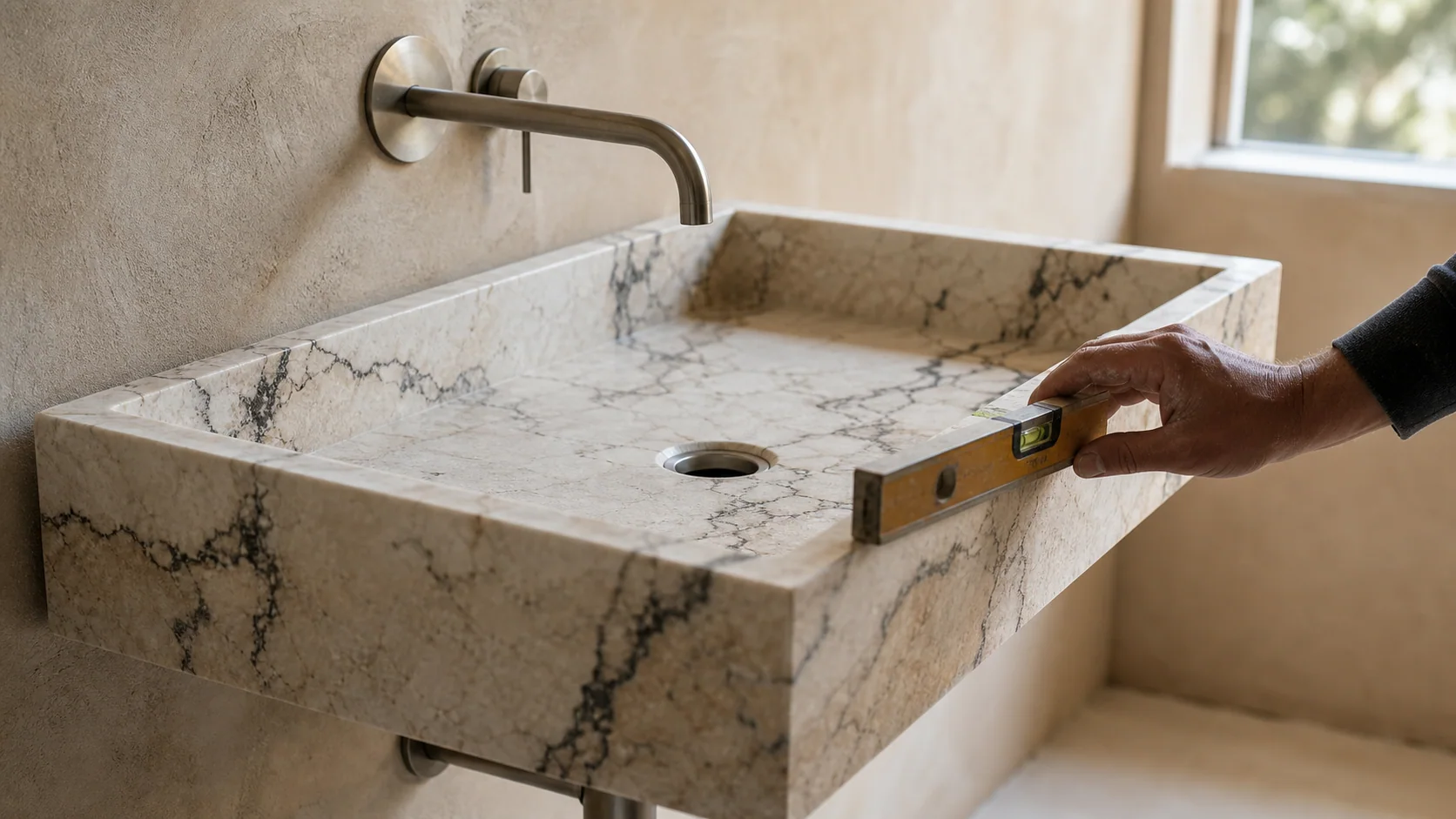
A complete guide to choosing a marble or travertine sink for a bathroom, powder room or hospitality project. Compare stone types, basin shapes, dimensions, installation methods, drainage, maintenance and international delivery before ordering.
A natural stone sink should be selected according to more than its colour or shape. The correct basin must suit the vanity dimensions, tap configuration, drainage system, installation method and daily maintenance requirements of the space.
Marble and travertine sinks can create a highly architectural bathroom, but natural stone is not a standardised material. Every block contains unique veins, pores, tonal movement and mineral markings. These natural characteristics influence both the appearance of the finished basin and the way it should be fabricated and cared for.
Whether you are searching for a marble sink, a travertine basin, a lavabo en pierre naturelle, a lavabo in marmo or a Waschbecken aus Naturstein, this guide explains the key decisions to make before ordering.
Why Choose a Natural Stone Sink?
A natural stone sink introduces material depth and permanence that cannot be fully replicated by printed porcelain, resin or standard ceramic surfaces. The basin becomes part of the architecture rather than appearing as a separate bathroom accessory.
A made-to-order stone sink can offer:
- Custom dimensions for a specific vanity or wall
- A choice of marble, travertine and other natural stones
- Integrated, vessel or countertop basin formats
- Honed or polished surface finishes
- Custom tap-hole and drainage positions
- Coordinated stone surfaces for vanities and splashbacks
- Residential or commercial project quantities
Natural stone sinks are particularly suitable for luxury bathrooms, powder rooms, boutique hotels, restaurants, spas and residential projects where the basin is intended to become a visual focal point.
What Is the Difference Between a Stone Sink and a Stone Vanity?
A stone sink refers specifically to the basin used for washing. A stone vanity is the wider bathroom unit or countertop surrounding the sink and may include storage, drawers, shelving or an integrated basin.
Common configurations include:
- A freestanding vessel basin placed on a separate vanity top
- An integrated basin carved or fabricated into the countertop
- A wall-mounted stone sink without a cabinet below
- A countertop with an undermount basin
- A complete vanity unit combining stone and internal storage
The correct solution depends on the size of the bathroom, storage requirements, plumbing location and desired architectural effect.
Which Natural Stone Is Best for a Bathroom Sink?
The best material depends on the colour palette, expected usage, surface finish and level of natural variation preferred by the customer.
You can compare current options through the DLA Stone material library.
Light Travertine
Light travertine is one of the most suitable choices for warm, minimal and Mediterranean-inspired bathrooms. Its beige and ivory tones work naturally with plaster walls, timber cabinetry, brushed brass and neutral tiles.
The linear movement of travertine creates a calm architectural appearance. Its natural pores may be filled during fabrication to create a smoother and more practical bathroom surface.
Silver Travertine
Silver travertine combines grey, taupe and beige tones. It creates a cooler and more contemporary result than light travertine while retaining the recognisable structure of natural stone.
It works well with dark timber, gunmetal taps, smoked glass and grey-toned interiors.
Nero Marquina
Nero Marquina is a black marble with contrasting white veining. It can create a strong graphic basin, particularly in powder rooms and bathrooms with controlled lighting.
Dark stone may show water residue more visibly than lighter materials, so regular drying and appropriate cleaning are important.
Dark Emperador
Dark Emperador introduces warm brown tones with lighter mineral movement. It pairs well with walnut cabinetry, bronze details, cream walls and warm architectural lighting.
Its deeper colour can make a bathroom feel more intimate and layered.
Rosso Levanto
Rosso Levanto offers deep burgundy colour with expressive white veining. It is particularly suitable for a statement powder room, boutique hospitality project or bathroom where the sink is intended to act as the central design feature.
Because the material has a strong visual identity, the surrounding surfaces should normally remain more restrained.
Onyx
Onyx offers distinctive translucency and layered colour. It may be used for highly decorative basins and illuminated architectural features, but it generally requires more careful material selection, fabrication and maintenance than many marbles or travertines.
Not every onyx block is suitable for every sink design. Technical feasibility should be confirmed before the material is specified.
Should You Choose a Vessel or Integrated Stone Sink?
The basin format influences the appearance, cleaning process, tap position and required vanity height.
Vessel Sinks
A vessel sink sits above the vanity top. It creates a sculptural and clearly defined object, making it suitable for powder rooms and statement bathrooms.
Advantages may include:
- A strong visual presence
- Greater freedom in basin shape
- Clear separation between basin and countertop
- The ability to combine contrasting stones
The total height must be planned carefully. A vessel basin placed on a standard-height vanity may become uncomfortable if the combined surface is too high.
Integrated Sinks
An integrated sink is formed within or directly connected to the countertop. It creates a cleaner and more architectural appearance with fewer visual interruptions.
Advantages may include:
- A continuous stone surface
- A minimal and refined appearance
- Greater design control over the basin dimensions
- Potential for coordinated splashbacks and side panels
Integrated sinks require detailed technical planning for slope, drainage, waterproofing, joints and access to plumbing.
Wall-Mounted Stone Sinks
A wall-mounted basin can create a lighter appearance by leaving the floor visible. This can be effective in compact bathrooms and contemporary interiors.
The supporting wall, brackets and installation method must be evaluated carefully because natural stone can be exceptionally heavy.
What Sink Shape Should You Choose?
Rectangular Basins
Rectangular sinks create a structured and architectural appearance. They work well with long vanities, linear mirrors and contemporary bathroom layouts.
Internal corners should be designed to support drainage and practical cleaning. Extremely sharp internal corners may be visually minimal but can be more difficult to maintain.
Round Basins
Round stone basins create a softer silhouette and work well as vessel sinks. They are suitable for compact powder rooms and bathrooms with curved mirrors or furniture.
A round form can also highlight the mineral movement of travertine or marble in a more continuous way.
Oval Basins
Oval sinks combine the softness of a round basin with additional horizontal space. They can provide a refined transition between traditional and contemporary bathroom styles.
Trough Sinks
A trough sink is a long basin that may serve one or two users. It is often selected for large residential bathrooms, shared vanities and hospitality projects.
The length, drainage position and slope must be carefully planned to prevent standing water across the basin.
Sculptural Basins
Sculptural sinks may include irregular curves, carved surfaces, fluted exteriors or monolithic forms. These designs can turn the basin into an art object, but technical practicality should remain a priority.
The design must still provide comfortable use, efficient drainage and adequate access for cleaning.
What Are the Ideal Stone Sink Dimensions?
The correct dimensions depend on whether the basin is used in a compact powder room, a standard bathroom or a larger double-vanity arrangement.
Common planning ranges may include:
- Compact vessel basin: approximately 35–40 cm wide
- Standard single basin: approximately 45–60 cm wide
- Large single basin: approximately 60–80 cm wide
- Trough or shared basin: approximately 90–140 cm wide
- Typical basin depth: approximately 30–45 cm
- Typical internal bowl depth: approximately 10–18 cm
These measurements are general references rather than fixed rules. Tap position, water pressure, splash control, vanity depth and intended usage must also be considered.
How High Should a Bathroom Sink Be?
The final height should be calculated from the floor to the usable rim or countertop surface.
Many bathroom vanities are planned around an overall height of approximately 80–90 cm. However, the correct height depends on the basin type and the users of the space.
For a vessel basin, the vanity itself usually needs to be lower because the basin adds height above the countertop.
For an integrated sink, the countertop and basin can often remain within the standard vanity-height range.
Before production, confirm:
- The height of the finished floor
- The thickness of the countertop
- The height of the vessel basin, where applicable
- The location of the wall-mounted or deck-mounted tap
- The height and position of the mirror
- The requirements of the intended users
Wall-Mounted or Deck-Mounted Tap?
The tap configuration should be confirmed before the stone is cut.
Wall-Mounted Taps
A wall-mounted tap creates a clean and minimal countertop. It can also provide more usable space around a vessel or integrated basin.
The position must be coordinated precisely with the basin centre, projection and finished wall surface.
Deck-Mounted Taps
A deck-mounted tap is installed through the vanity top or sink surface. This configuration requires accurately positioned tap holes and sufficient structural space around the basin.
The distance between the tap outlet and basin must be selected to reduce splashing while keeping the tap comfortable to use.
Freestanding Taps
Freestanding taps may be used with larger sculptural or floor-standing basins. They require floor-level plumbing coordination and sufficient room around the sink.
Why Is Drainage Planning Important?
A beautiful sink is not successful if water remains on the surface or drains inefficiently.
Drainage depends on:
- The internal basin slope
- The position and diameter of the waste outlet
- The shape of the basin
- The flow rate of the tap
- The connection between stone and plumbing components
- The accuracy of installation
For integrated and trough sinks, the slope should guide water toward the outlet without creating an uncomfortable or visibly excessive angle.
The waste fitting, trap and plumbing access should be confirmed with the installer before production.
What Information Does DLA Stone Need Before Production?
To evaluate a custom stone sink, provide:
- Required width, depth and height
- Preferred stone
- Vessel, integrated or wall-mounted configuration
- Tap type and tap-hole requirements
- Waste outlet size and position
- Vanity or wall dimensions
- Reference images or technical drawings
- Delivery country and postcode
For complex projects, plumbing drawings and final site measurements may be required before production begins.
Submit custom requirements through the DLA Stone bespoke service.
Will You See the Stone Before Production?
Natural stone varies from one block and slab to another. Product photographs show the design and general material character but cannot guarantee an identical future pattern.
DLA Stone provides photographs of the selected stone before production so the customer can review its overall colour, vein density and natural movement.
These photographs confirm the general material selection but are not a guaranteed digital vein-placement mock-up. Final positioning depends on the basin dimensions, cutting requirements, drainage, joints and technical feasibility.
How Are Natural Stone Sinks Constructed?
The construction method depends on the design and selected material.
Some sinks may be carved from a solid block or substantial stone section. Others may be assembled from precision-cut natural stone panels to create a larger integrated form.
The selected method depends on:
- The dimensions of the sink
- The basin shape
- The selected stone
- Drainage requirements
- The desired edge profile
- The weight of the finished piece
- Installation and transport conditions
Joints, internal corners and drainage details should be positioned to support both the visual quality and functional performance of the sink.
Honed or Polished Finish?
The finish affects colour, reflection and day-to-day appearance.
Honed stone has a smooth, low-sheen surface. It creates a softer and more contemporary result and is commonly selected for understated bathrooms.
Polished stone reflects more light and intensifies the stone’s colour and veining. It may create a more formal or decorative effect.
Water marks, soap residue and fingerprints can appear differently on each finish and stone colour. Dark polished stone may require more frequent drying to maintain a clean appearance.
Read the DLA Stone comparison of honed and polished natural stone finishes before choosing.
Does a Natural Stone Sink Need Sealing?
Natural stone is porous to varying degrees. Appropriate sealing can help reduce absorption and make regular maintenance more manageable.
The correct sealing approach depends on the stone, finish, basin construction and expected use. Sealing does not make marble or travertine completely stain-proof or maintenance-free.
Customers should:
- Use products intended for natural stone
- Follow the sealer manufacturer’s instructions
- Test products on a discreet area where possible
- Reapply treatment according to use and product guidance
- Avoid mixing incompatible chemicals
How Should a Marble or Travertine Sink Be Cleaned?
Routine cleaning should be gentle and consistent.
- Rinse soap and cosmetic residue regularly
- Use a soft cloth or non-abrasive sponge
- Choose a pH-neutral stone cleaner
- Avoid vinegar, lemon and acidic bathroom products
- Do not use abrasive powders or rough pads
- Dry dark stone to reduce visible water marks
- Do not allow harsh hair dyes or chemicals to remain on the surface
Detailed maintenance guidance is available in the DLA Stone product care guide.
Can Natural Stone Be Used in a Frequently Used Bathroom?
Yes, provided the sink is designed, installed and maintained correctly. Natural stone has been used in bathrooms for centuries, but it develops character differently from ceramic or synthetic surfaces.
Daily use may gradually create a natural patina. Minor tonal changes, surface marks or softening of the finish can become part of the material’s appearance over time.
Customers seeking a completely uniform and maintenance-free surface may prefer a different material. Customers who value natural variation and ageing often consider these changes part of the appeal of stone.
Natural Stone Sinks for Hotels and Commercial Projects
Hospitality and commercial bathrooms require additional planning because the sinks may be used more frequently than in a private home.
Project considerations may include:
- Quantity and dimensional consistency
- Stone availability for multiple units
- Cleaning procedures
- Replacement planning
- Plumbing standardisation
- Installation sequence
- Accessibility requirements
- Commercial project deadlines
Interior designers, architects, developers and hospitality professionals can apply to the DLA Stone Trade Program for project support, bespoke production and applicable commercial terms.
How Long Does Production Take?
DLA Stone pieces are made to order in its Turkish atelier. Standard production generally takes approximately 4–8 weeks, depending on the stone, dimensions, basin design and current workshop schedule.
The process may include:
- Review of dimensions and technical requirements
- Confirmation of the selected stone
- Assessment of plumbing and drainage details
- Stone cutting or carving
- Assembly and joint preparation where required
- Surface finishing
- Drainage and dimensional quality control
- Protective crating for international transport
Complex integrated vanities, large trough sinks and limited-availability stones may require additional time.
How Is a Natural Stone Sink Delivered?
Natural stone sinks require specialist packing because the basin edges, internal corners and drainage areas can be vulnerable during transport.
DLA Stone pieces are packed in protective ISPM-15 compliant wooden crates. Eligible shipments are insured for up to 110% of the purchase value.
Complimentary DDP kerbside delivery is available to the European Union, United Kingdom, Switzerland, Norway and Türkiye according to the confirmed destination and order terms.
Standard delivery does not include:
- White-glove service
- Indoor carrying
- Unpacking
- Plumbing connection
- Wall mounting
- Installation
- Removal of the wooden crate
A qualified stone installer and plumber should be arranged before delivery. Review the complete DLA Stone shipping and delivery policy before ordering.
Frequently Asked Questions
Is marble suitable for a bathroom sink?
Yes. Marble can be used for bathroom sinks when the basin is correctly fabricated, sealed, installed and maintained. Acidic or abrasive cleaning products should be avoided.
Is travertine too porous for a sink?
Travertine is naturally porous, but suitable filling, finishing and sealing can make it appropriate for bathroom use. Regular maintenance remains important.
Can I order a custom-sized natural stone sink?
Yes. Custom dimensions can be evaluated according to the selected stone, basin shape, drainage, tap configuration and structural requirements.
Can the sink and vanity top be produced as one piece?
Integrated sink and countertop designs can be assessed. Feasibility depends on the total dimensions, material, transport weight and fabrication method.
Can tap holes be prepared before delivery?
Yes, when the exact tap model, measurements and required positions are confirmed before production. Incorrect or incomplete measurements can create installation problems.
Will I see the selected stone before production?
DLA Stone provides photographs of the selected material so the customer can review its general colour, veining and natural character before production begins.
Does the sink include plumbing fittings?
The included components depend on the specific order. Waste fittings, taps, traps and plumbing connections should be confirmed separately before production.
Does delivery include installation?
No. Standard delivery is kerbside and does not include carrying, unpacking, plumbing or installation.
How long does production take?
Standard production generally takes 4–8 weeks. Large, complex or materially specific projects may require additional time.
Create a Bathroom Around Natural Stone
A successful stone sink combines material character with practical planning. The stone must complement the interior, but the dimensions, basin depth, tap position, drainage and installation method are equally important.
Light travertine can create a calm architectural bathroom, while Nero Marquina, Dark Emperador, Rosso Levanto or onyx can introduce stronger colour and contrast. The right selection depends on the atmosphere of the space and the level of natural variation preferred by the customer.
Explore the DLA Stone collection, compare current materials in the natural stone library or submit a custom sink and vanity enquiry.