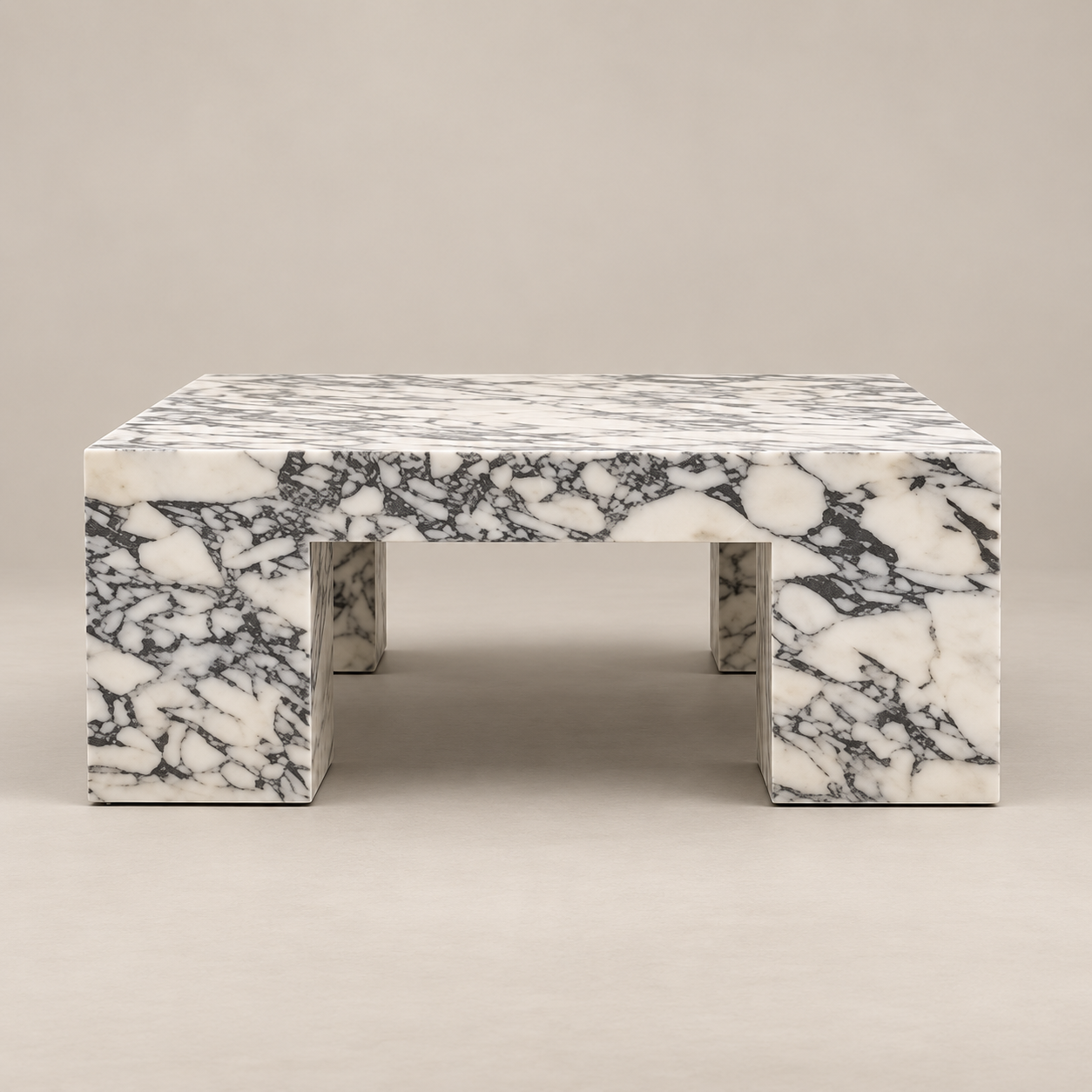
Compare honed and polished marble by appearance, daily use and care. Confirm the right stone finish and treatment for your dining table or coffee table.
The finish changes how natural stone catches light, how its pattern reads and how marks appear in everyday use. Polished and honed are two common choices for marble furniture, but neither is a protective coating or a guarantee against staining.
What is polished marble?
A polished surface is worked with progressively finer abrasives to produce a reflective sheen. Colours and contrasting veins can appear more pronounced, making it a strong choice when the stone is intended to be a focal point.
Reflections also make dust, fingerprints and dull patches more noticeable in some lighting. An acidic spill can etch a polished surface even when it has been sealed.
What is honed marble?
A honed surface is smooth with a matte or low-sheen appearance. It usually gives the stone a quieter visual presence and can work well with linen, timber and restrained interiors.
Some small marks may be less visually obvious than on a highly reflective surface. That does not mean the stone is scratch-proof, stain-proof or suitable for rough use.
Which finish suits a dining or coffee table?
Choose polished if you prefer stronger reflections and more dramatic contrast. Choose honed if you prefer a softer surface appearance. Assess both in the light of the actual room, alongside upholstery, flooring and other reflective materials.
Daily use is possible with either finish when the piece is specified and cared for appropriately. Use mats and coasters, remove spills promptly and choose a compatible neutral cleaner.
Does finish determine staining?
Absorption depends on the specific stone, surface preparation and treatment as well as the finish. Avoid assuming every honed marble is more absorbent than every polished marble. Sealing requirements should be confirmed for the particular material and product.
A sealer can help reduce absorption but cannot prevent acid etching. Follow the supplied treatment guidance instead of a fixed universal resealing interval.
Can a finish be changed later?
Professional restoration can sometimes change or restore a finish, but feasibility depends on the shape, access, stone and construction. This is not a routine household polishing job. Consult a stone-restoration specialist before treating a finished piece.
Travertine and other textured finishes
With travertine, ask whether voids are filled or open as well as whether the surface is honed or polished. Texture and filling affect cleaning and the tactile character of the piece. Brushed or other specialist finishes should be assessed separately for the intended use.
Confirm your specification before ordering
Finish availability varies by material and design. Confirm the exact stone, sheen, edge detail and any special treatment on the product page or written quotation. A reference photograph alone may not show these details accurately.
Explore our material library, read marble care advice or contact DLA Stone to discuss a particular finish.