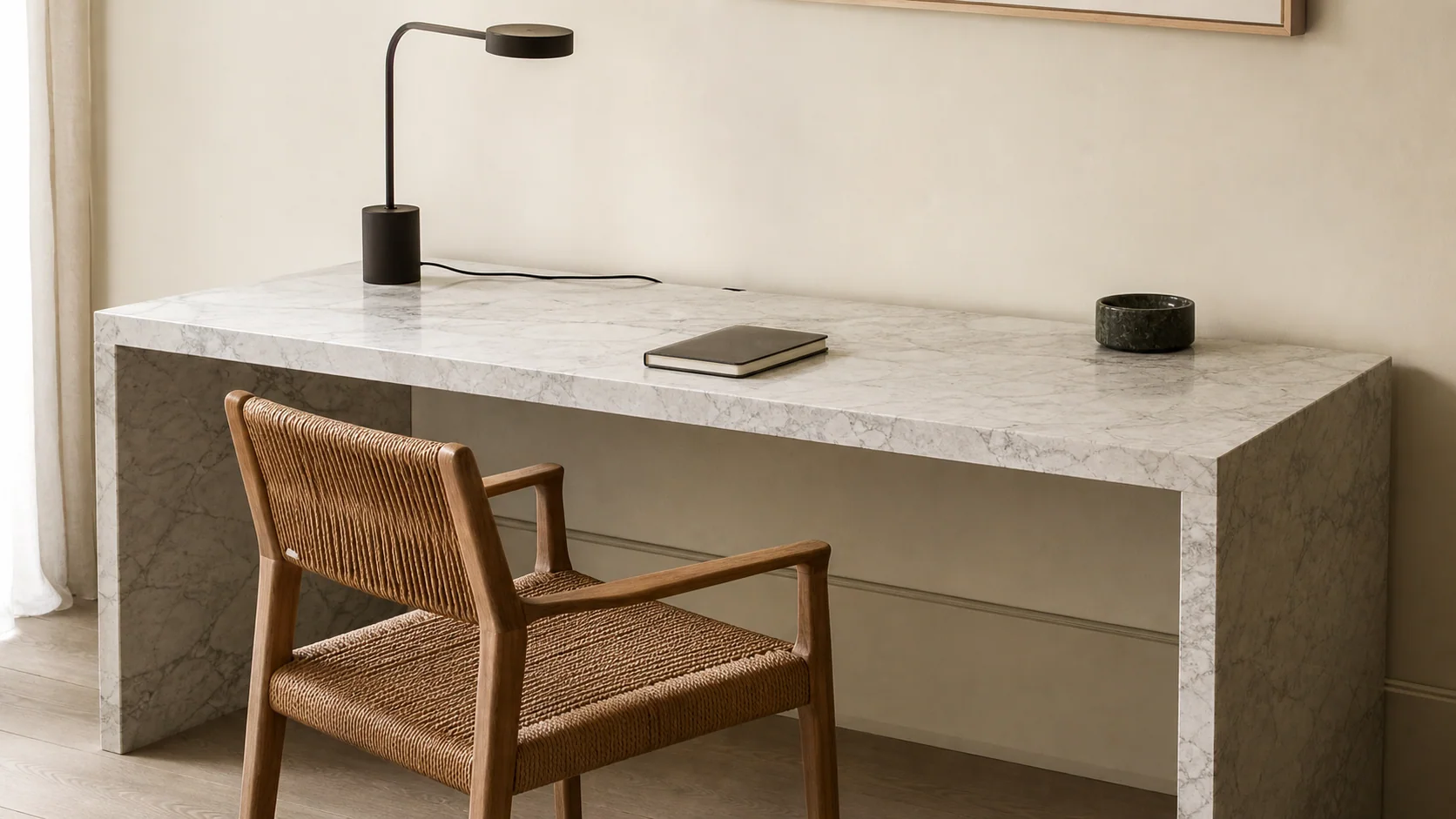
A complete guide to choosing a marble, travertine or natural stone desk for a home office, private study or professional workspace. Compare ideal dimensions, ergonomics, stone selection, construction, cable management, finishes, delivery and care before ordering.
A natural stone desk should combine architectural presence with practical everyday performance. The stone may define the visual character of the piece, but the correct dimensions, legroom, structural support, cable management and surface finish determine whether the desk is comfortable to use.
Marble and travertine desks are substantially different from lightweight timber or metal furniture. Natural stone has greater physical and visual weight, varies from one slab to another and requires specialist fabrication, packing and delivery.
Whether you are searching for a marble desk, a luxury stone writing table, a Schreibtisch aus Marmor, a bureau en marbre or a scrivania in marmo, this guide explains the decisions to make before commissioning a made-to-order natural stone workspace.
Why Choose a Natural Stone Desk?
A natural stone desk can function as both a workspace and a sculptural piece of furniture. Unlike a conventional office desk designed primarily around storage and mass production, a made-to-order stone desk can be developed according to the proportions and material language of the interior.
A custom natural stone desk may offer:
- Dimensions selected for the user and room
- A choice of marble, travertine and other suitable stones
- Custom base proportions
- Honed or polished surface finishes
- Integrated cable openings
- Rounded or refined edge profiles
- Single-person or shared workspace formats
- Coordination with other natural stone furniture
Stone desks work particularly well in private studies, executive offices, luxury home offices, libraries, hotel suites and design-led commercial interiors.
What Is the Ideal Height for a Desk?
Many standard desks measure approximately 72–76 cm high. However, the correct height depends on the user, chair, working position and thickness of the tabletop.
A desk that is too high can raise the shoulders and create an uncomfortable typing position. A desk that is too low may restrict the legs and encourage poor posture.
Before confirming the height, consider:
- The user’s height
- The seat height of the selected chair
- Whether the chair has adjustable arms
- The thickness of the stone top
- The position of drawers or supports beneath the desk
- The type of work performed at the desk
The forearms should generally be able to rest comfortably while the shoulders remain relaxed. An adjustable office chair provides some flexibility, but it cannot correct every dimensional problem.
How Wide Should a Natural Stone Desk Be?
The correct width depends on whether the desk will be used for writing, a laptop, a large monitor or a complete professional workstation.
Useful planning ranges may include:
- 100–120 cm: Compact writing desk or laptop workspace
- 120–140 cm: Comfortable single-person home-office desk
- 140–160 cm: Suitable for a monitor, laptop and desk accessories
- 160–180 cm: Executive desk or dual-monitor workspace
- 180 cm and above: Large office, shared desk or statement workspace
These dimensions are starting points rather than fixed rules. A stone desk may feel visually heavier than a timber desk of the same size, particularly when it has a thick top and substantial pedestal bases.
For Laptop Use
A laptop-focused workspace can remain relatively compact. However, space should still be provided for a notebook, lamp, charging accessories and comfortable arm movement.
For a Single Monitor
A wider and deeper surface is normally preferable when the desk includes a monitor, keyboard and separate mouse. The screen should not sit so close that the user is forced into a restricted viewing position.
For Two Monitors
A dual-monitor setup may require a desk approximately 160 cm wide or more, depending on the screen dimensions and positioning. Cable access and the load created by monitor arms should be considered during technical planning.
How Deep Should a Stone Desk Be?
Desk depth affects screen distance, usable working space and overall comfort.
Many desks fall between approximately 60 and 80 cm deep.
- 55–60 cm: Compact writing or occasional-use desk
- 60–70 cm: Suitable for laptops and smaller monitors
- 70–80 cm: Better for larger monitors and professional use
- 80 cm and above: Executive desks and generous workspaces
A very shallow desk may look elegant but become impractical once a monitor, keyboard and accessories are added. A very deep desk may occupy unnecessary floor space and make the rear section difficult to reach.
How Much Legroom Does a Desk Need?
Legroom should be evaluated before selecting the base design. Sculptural pedestals may look impressive but can restrict movement when they are positioned too close to the centre.
The space beneath the desk should provide sufficient room for:
- The user’s knees
- Natural movement of the legs
- The width of the office chair
- Chair arms, where applicable
- Movement between sitting and standing
- Any footrest or under-desk accessories
Two pedestal bases can work well on a wide desk when they are positioned toward the ends. A central monolithic base may be suitable for a smaller writing table but should be assessed carefully for knee clearance.
If drawers are required beneath the top, their dimensions should be included in the ergonomic calculation rather than added after the desk proportions have been confirmed.
Which Natural Stone Is Best for a Desk?
The selected stone should complement the room while remaining appropriate for regular use. Colour, pattern, finish and natural variation all influence how the desk feels within the workspace.
Current material options can be reviewed through the DLA Stone Material Library.
Verde Alpi
Verde Alpi is a deep green marble with pale and darker mineral movement. It can create a sophisticated desk for private studies, executive offices and interiors featuring walnut, bronze, leather or warm neutral walls.
The green surface gives the workspace a strong identity without relying on bright decorative colour. A honed finish can soften the contrast and create a more restrained architectural appearance.
Because Verde Alpi has expressive natural movement, the amount and direction of veining should be considered in relation to the desk width. A broad tabletop provides more space for the stone pattern to develop.
Emperador Light
Emperador Light introduces caramel, beige and warm brown tones with intricate mineral veining. It works well in offices that use oak, walnut, cream upholstery and warm metallic details.
Its layered colour creates more visual depth than plain beige stone while remaining softer than strongly contrasting black or burgundy marbles.
Silver Travertine
Silver travertine combines grey, taupe and beige linear movement. It is suitable for contemporary workspaces with dark timber, anthracite metal, smoked glass and neutral textiles.
The directional structure of travertine can be used to emphasise the length of the desk. The cutting direction should therefore be considered during material planning.
Light Travertine
Light travertine creates a calm and minimal workspace. Its ivory and warm beige tones work naturally with plaster walls, oak, linen and soft architectural lighting.
It is particularly suitable where the desk should feel substantial without visually dominating the room.
Nero Marquina
Nero Marquina can produce a graphic black desk with strong white veining. It works well in monochrome offices, contemporary studies and interiors with controlled lighting.
Dark surfaces can show dust, fingerprints and dried liquid marks more clearly, so the practical maintenance expectations should be considered before selection.
Onyx as an Accent Material
Onyx can introduce translucency and distinctive layered colour, but it may not be the most practical choice for every full-size working surface.
Depending on the design, onyx may be better used as a decorative panel, modesty panel, pedestal detail or illuminated accent rather than the primary desktop. Technical suitability should be confirmed for each project.
Should the Desk Be Solid Stone or Stone-Clad?
Natural stone desks can be produced using different construction methods.
Some designs may use substantial solid-stone sections. Others use an engineered internal structure clad in genuine marble or travertine.
Solid-stone construction can create a monolithic object but may result in exceptional weight, particularly across a large desktop and two substantial bases.
Engineered stone-clad construction can reduce unnecessary weight while preserving the appearance, surface and edge continuity of real natural stone.
The correct method depends on:
- The total width and depth
- The distance between supports
- The selected stone
- The desired top thickness
- The base design
- The equipment placed on the desk
- Transport and installation access
Neither method is automatically superior. The structure should be selected according to the visual and technical requirements of the design.
Why Does the Distance Between the Bases Matter?
Natural stone is strong under compression but desk design must still account for span, support placement and concentrated loads.
A very long top with supports positioned too far apart may require additional engineering. This becomes especially relevant when the desk includes:
- A large unsupported central span
- A thick visual profile
- Heavy monitors
- Monitor arms attached to the rear edge
- Stone drawers or storage elements
- An asymmetrical base arrangement
The bases should provide stability without restricting the user’s chair or knees. Visual minimalism should not be achieved by removing necessary structural support.
How Should Cables Be Managed?
Cable management should be planned before the stone is cut. Adding openings after delivery can be difficult, risky and may invalidate carefully prepared edge or surface details.
Before production, identify:
- The number of monitors
- Laptop and phone chargers
- Desk lamps
- Speakers
- Printers or other equipment
- Floor or wall socket positions
- Whether a cable tray will be used
Cable Apertures
A circular or rectangular cable opening can be prepared in the desktop. The size and location should relate to the equipment and should not interfere with the stone’s structural support.
Rear Cable Channels
A discreet channel near the rear edge can allow several cables to pass behind the desk. This may create a cleaner surface than multiple individual openings.
Integrated Cable Trays
A metal or timber cable tray can be positioned beneath the desk. The fixing method should be planned as part of the internal structure rather than drilled into the finished stone without technical approval.
Floor Boxes
For desks positioned in the centre of a room, a floor box can provide a cleaner electrical connection. Its location must be coordinated with the final desk position and base layout.
Can a Stone Desk Include Drawers?
Yes, but drawers increase the complexity of the structure. Natural stone may be combined with timber, metal or engineered internal components to create practical storage.
Before designing drawers, confirm:
- The number and width of the drawers
- Required internal depth
- Handle or handleless operation
- Soft-close mechanisms
- The relationship between storage and legroom
- The position of internal supports
- Cable access requirements
A desk does not need to be made entirely from one material. Combining stone with dark timber, walnut veneer or refined metal components can improve functionality while preserving a cohesive luxury appearance.
What Edge Profile Is Best for a Desk?
The edge profile affects comfort, visual weight and durability.
Straight Edge
A clean straight edge creates a structured architectural appearance. The corners should be refined sufficiently to remain comfortable during daily use.
Softened Edge
A lightly softened edge retains a minimal look while reducing the sharpness of the desktop. This is often practical for writing and computer work.
Rounded Corners
Rounded corners improve circulation and create a softer visual character. They can be particularly useful when the desk is positioned in the centre of a room or near a walkway.
Thick Architectural Profile
A thick-looking top creates a substantial statement. Depending on the construction, the profile may be developed without requiring the entire visual thickness to be solid stone.
Honed or Polished Finish?
The finish determines how strongly the stone reflects light and displays fingerprints, equipment and surrounding objects.
Honed stone has a smooth, low-sheen surface. It creates a quieter and more contemporary workspace and reduces strong reflections from windows and desk lighting.
Polished stone intensifies colour and veining. It can create a more formal and decorative result but may reflect monitors, windows and lamps more noticeably.
For many working environments, a honed finish offers a balanced combination of tactile quality and controlled reflection. However, the ideal finish depends on the selected stone and interior concept.
Read the DLA Stone guide to honed and polished natural stone finishes for a more detailed comparison.
Where Should a Stone Desk Be Positioned?
The desk location affects comfort, privacy, glare and the overall room composition.
Facing a Window
A desk facing a window can provide natural light and an open view. However, direct sunlight may create screen glare and strong heat at certain times of day.
Perpendicular to a Window
Positioning the desk perpendicular to the window can provide balanced side lighting while reducing direct glare on the monitor.
In the Centre of the Room
A freestanding desk can create an executive and architectural layout. Cable routing and the appearance of the rear side become especially important because the desk will be visible from multiple angles.
Against a Wall
A wall-positioned desk can save space and simplify cable management. Ensure that there is sufficient clearance for the chair and that the desk does not obstruct radiators, sockets or doors.
How Much Space Should Be Left Behind the Chair?
The user should be able to move the chair and stand up without contacting a wall or another piece of furniture.
Approximately 90 cm behind the chair can provide a useful starting point for many home offices. More space may be necessary where another person must walk behind the seated user.
When planning the room, account for:
- The full depth of the desk
- The chair when occupied
- The chair when pulled backwards
- Storage units and bookcases
- Door-opening directions
- Primary circulation routes
Will You See the Stone Before Production?
Natural stone varies in colour, veining, texture and mineral movement. Product photographs and material samples cannot guarantee that a future piece will be visually identical.
DLA Stone provides photographs of the selected material before production so the customer can review its overall colour and natural character.
These photographs are used for general material approval. They are not a guaranteed digital vein-placement mock-up. Final positioning depends on the desktop dimensions, cutting direction, usable stone areas, joints and technical requirements.
How Long Does a Custom Stone Desk Take to Produce?
DLA Stone furniture is made to order in its Turkish atelier. Standard furniture production generally takes approximately 4–8 weeks, depending on the dimensions, selected material, construction and workshop schedule.
The process may include:
- Confirmation of dimensions and use requirements
- Technical review of the top and base structure
- Material selection and photographic approval
- Stone cutting and structural preparation
- Preparation of cable openings or storage components
- Assembly and edge finishing
- Honing or polishing
- Quality control
- Protective crating
Complex desks with drawers, integrated cable systems or unusually large dimensions may require additional production time.
How Is a Natural Stone Desk Delivered?
A stone desk may be delivered as one piece or in separate components, depending on the design, weight and installation requirements.
The access route should be reviewed before production. Check:
- Road and vehicle access
- Building entrances
- Door widths
- Lift dimensions and weight limits
- Stairs and turning areas
- The final office location
- Whether specialist lifting equipment is required
Where an order or quotation states DDP, the confirmed price can include international freight, customs procedures, applicable duties and taxes, and standard kerbside delivery.
Kerbside delivery does not include indoor carrying, upstairs delivery, room-of-choice placement, unpacking, assembly or specialist lifting. Review the DLA Stone Shipping & Delivery Policy before approving the order.
How Should a Marble or Travertine Desk Be Maintained?
A desk is exposed to coffee, ink, metal accessories, electronic equipment and frequent hand contact. Everyday protection is therefore important.
- Use coasters beneath drinks
- Use a desk mat beneath keyboards and writing areas
- Wipe spills promptly
- Clean with a soft cloth and pH-neutral stone cleaner
- Avoid acidic or abrasive cleaning products
- Use felt pads beneath lamps and accessories
- Do not drag monitors or metal objects across the surface
- Avoid attaching equipment without confirming the fixing method
Natural stone can develop a patina with use. Detailed guidance is available in the DLA Stone Product Care Guide.
Natural Stone Desks for Interior Designers and Commercial Projects
Architects and interior designers may specify custom desks for executive offices, hotel suites, private residences, reception rooms and luxury workspaces.
Professional projects may require:
- Custom dimensions
- Coordinated stone selection
- Integrated power and data access
- Storage components
- Multiple matching desks
- Technical drawings
- Delivery sequencing
- Commercial project timelines
Eligible professionals can apply to the DLA Stone Trade Program for preferential pricing, dedicated project assistance, stone samples and bespoke production support.
Frequently Asked Questions
Is marble practical for a desk?
Yes, when the surface is correctly fabricated and used with appropriate care. Coasters, desk mats and pH-neutral cleaning products help protect the stone during everyday use.
What is the ideal height for a marble desk?
Many desks measure approximately 72–76 cm high. The correct height depends on the user, chair, tabletop thickness and working position.
How wide should a home-office desk be?
A compact laptop desk may begin around 100–120 cm wide. A comfortable monitor-based workspace commonly requires approximately 140–160 cm or more.
Can a stone desk include cable holes?
Yes. Cable openings and channels can be prepared when their dimensions and positions are confirmed before production.
Can a marble desk include drawers?
Yes. Drawers can be incorporated using a technically suitable internal structure, often combining natural stone with timber, metal or engineered components.
Is a solid-marble desk always better?
No. The correct construction depends on the dimensions, span, weight, base arrangement and delivery requirements. An engineered stone-clad structure may be more appropriate for some large designs.
Will I see the stone before production?
DLA Stone provides photographs of the selected material so the customer can review its overall colour, veining and natural character before production.
How long does production take?
Standard furniture production generally takes 4–8 weeks. Complex storage, cable-management systems or oversized dimensions may extend the schedule.
Does delivery include placing the desk inside the office?
No. Standard kerbside delivery does not include indoor carrying, upstairs delivery, unpacking, assembly or room placement.
Create a Workspace Around Natural Stone
A successful stone desk is not defined by material alone. The width, depth, height, support structure, legroom and cable management must work together to create a comfortable and functional workspace.
Verde Alpi can create a bold and sophisticated private study, Emperador Light can introduce warmth, and silver or light travertine can produce a quieter architectural office.
Explore the DLA Stone Material Library, submit a custom natural stone desk enquiry or apply to the Trade Program for residential and commercial projects.