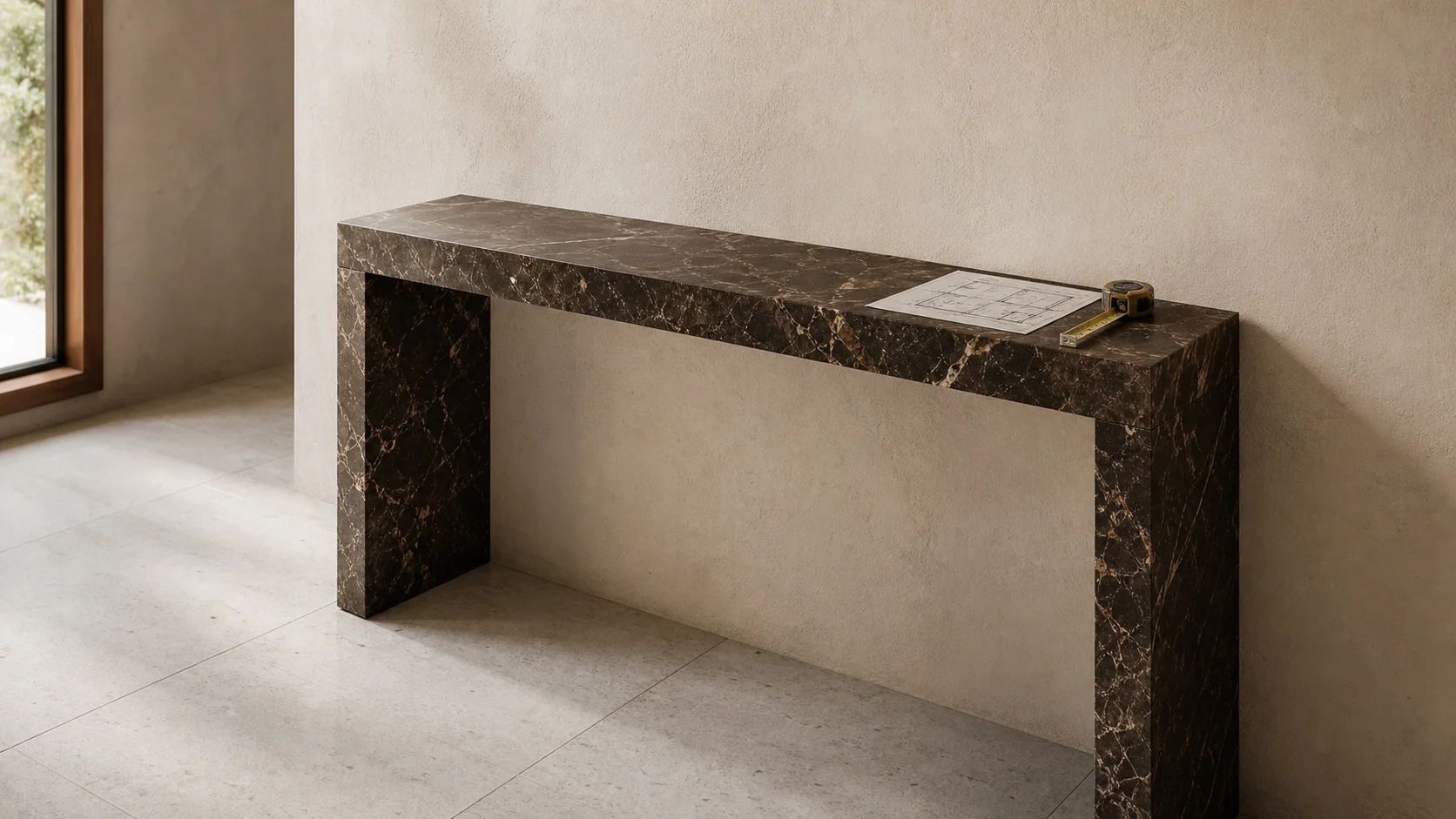
Discover how to choose a marble or travertine console table for an entrance, living room, dining area or hallway. Compare dimensions, height, stone selection, construction, placement, styling and international delivery before ordering.
A natural stone console table should be selected according to the space in which it will be used, not only according to its appearance. The correct piece must balance width, depth, height, stone character and structural stability while leaving enough room for comfortable circulation.
Marble and travertine consoles can be used in entrance halls, living rooms, dining areas, bedrooms and commercial interiors. Because natural stone has considerable visual and physical weight, even a relatively narrow console can become an architectural focal point.
Whether you are searching for a marble console table, a travertine hallway table, a console en marbre sur mesure or a Marmorkonsole nach Maß, this guide explains the most important details to consider before ordering.
What Is a Console Table?
A console table is a narrow piece of furniture designed to sit against a wall, behind a sofa or within a circulation area. It provides a practical surface without occupying the depth of a dining table, desk or storage unit.
Natural stone console tables are commonly used:
- In entrance halls
- Along narrow corridors
- Behind freestanding sofas
- Against living room walls
- In dining rooms beneath artwork or mirrors
- As compact dressing or display surfaces
- In hotel lobbies, restaurants and reception areas
A console may be purely decorative or serve a practical function. Before selecting a design, decide whether the surface needs to support lighting, artwork, books, everyday objects or heavier decorative pieces.
How High Should a Console Table Be?
Most console tables are approximately 75–90 cm high. The ideal height depends on the room, surrounding furniture and how the surface will be used.
A lower console can create a relaxed, contemporary appearance. A taller console may provide greater presence in an entrance hall or beneath a large mirror.
Console Tables in Entrance Halls
For an entrance or hallway, a height of approximately 80–90 cm is generally practical. This creates an accessible surface for keys, trays, flowers and lighting while maintaining a visually balanced relationship with mirrors or artwork.
Console Tables Behind a Sofa
A console positioned behind a sofa should normally sit close to the height of the sofa back or slightly below it. If the console is significantly taller, it may appear disconnected and obstruct sightlines across the room.
Measure the sofa from the floor to the highest point of the back before selecting the console height.
Console Tables in Dining Rooms
A dining room console may be used as a display surface or for serving accessories. A height of approximately 75–85 cm often works well, depending on the dining table and surrounding furniture.
How Wide Should a Console Table Be?
The width of a console should relate to the wall, sofa or architectural feature beside which it will be placed.
Common console widths may include:
- 80–100 cm: Suitable for compact halls and smaller interiors
- 100–130 cm: A versatile size for many entrances and living rooms
- 130–160 cm: Suitable for larger walls, dining areas and sofa-back placement
- 160 cm and above: Better suited to generous residential or commercial spaces
A console that is too narrow may appear insignificant beneath large artwork or a wide mirror. A piece that is too wide can make a hallway feel congested and reduce usable circulation space.
When placing a console beneath a mirror or artwork, the decorative element should generally be narrower than the console rather than extending significantly beyond its edges.
How Deep Should a Console Table Be?
Depth is one of the most important measurements, especially in narrow corridors and entrance halls.
Many console tables are approximately 30–45 cm deep. Slimmer designs can work in compact circulation areas, while deeper consoles provide more usable surface space.
- 25–30 cm: Suitable for very narrow hallways and decorative use
- 30–35 cm: Practical for compact entrances
- 35–40 cm: A versatile depth for lighting and accessories
- 40–45 cm: Suitable for larger interiors and substantial styling
Natural stone has strong visual weight, so a deep marble console can appear more substantial than a timber console of identical dimensions.
How Much Space Should Be Left Around a Console Table?
A console table should not interrupt the primary walking route through a room.
Before ordering, measure:
- The total width of the hallway or room
- The console depth
- The remaining walking space
- The opening direction of nearby doors
- The position of radiators, sockets and switches
- The route required for delivery
A comfortable circulation route generally requires approximately 80–90 cm of clear space. Busy entrances and commercial interiors may require more.
If the console will be placed behind a sofa, check that the remaining route does not feel compressed once both pieces are in position.
Where Can a Natural Stone Console Table Be Used?
In an Entrance Hall
A marble or travertine console can establish the visual character of a home from the moment a guest enters. The surface may support a lamp, bowl, vase or sculptural object, while the stone introduces texture and permanence.
For compact entrances, select a relatively narrow piece and avoid excessive decorative objects. Leave enough of the natural stone visible for the material to remain the focus.
Behind a Sofa
A console behind a freestanding sofa can divide an open-plan room without using a solid partition. It may also provide a surface for lighting, books or decorative objects.
The console should normally be slightly shorter than the sofa and should not extend significantly beyond either side.
In a Dining Room
A natural stone console can complement a marble or travertine dining table without needing to match it exactly. Using the same stone creates continuity, while a contrasting material can add depth.
For example, a light travertine dining table can be paired with a Calacatta Viola or Rosso Levanto console as a controlled statement piece.
In a Living Room
A console positioned beneath artwork can fill an empty wall and create a visual connection between furniture and architecture. It may also function as a compact bar surface or display area.
In a Bedroom
A narrow stone console can be used as a dressing surface or decorative table. The depth should remain appropriate for the room, particularly where the console is placed opposite the bed.
In Hospitality and Commercial Interiors
Marble and travertine consoles can be specified for hotels, restaurants, reception spaces and luxury retail environments. In commercial projects, durability, dimensions, placement and quantity planning should be evaluated together.
Which Natural Stone Is Best for a Console Table?
The selected stone determines the colour, movement and visual weight of the finished piece. You can compare current options through the DLA Stone material library.
Light Travertine
Light travertine creates a warm, calm and architectural appearance. It works naturally with plaster walls, oak, walnut, linen and neutral upholstery.
Its relatively quiet pattern makes it suitable for wider consoles and interiors where the stone should complement rather than dominate the room.
Silver Travertine
Silver travertine combines grey, taupe and beige tones with linear movement. It can create a more contemporary and graphic result than light travertine.
It pairs well with dark wood, brushed metal, smoked glass and cooler neutral palettes.
Calacatta Viola
Calacatta Viola is suitable for a statement console with strong burgundy, violet and grey veining on a warm white background.
A long console provides enough surface area for the movement of Calacatta Viola to become highly visible. For this reason, the selected material photographs should be reviewed carefully before production begins.
Nero Marquina
Nero Marquina creates a dark, graphic and architectural appearance. Its black background can anchor a bright entrance or add depth to a room dominated by cream and beige tones.
Rosso Levanto
Rosso Levanto introduces rich burgundy colour and expressive white veining. It works particularly well in interiors that use walnut, bronze, deep red accents and warm lighting.
Dark Emperador
Dark Emperador offers warm brown tones with lighter mineral movement. It is suitable for layered interiors using leather, timber, bronze and darker textiles.
Should the Console Match the Coffee or Dining Table?
A console does not need to be an exact material match with the other furniture in the room. In many interiors, using different but complementary stones creates a more considered result.
There are three main approaches:
Use the Same Stone
Selecting the same stone for the console and another table creates visual continuity. This approach works well in minimalist interiors and open-plan spaces.
Use a Tonal Stone
A tonal combination uses materials with related background colours but different patterns. Light travertine and warm white marble, for example, can coexist without appearing identical.
Use a Contrasting Stone
A contrasting console can act as a focal point. Calacatta Viola or Rosso Levanto may be paired with quieter travertine furniture to introduce stronger colour and movement.
The contrast should feel intentional. Repeating one colour from the stone elsewhere in the room can help connect the piece to the wider interior.
Solid Stone or Stone-Clad Construction?
Natural stone console tables can be produced using different structural methods.
Some designs may use solid natural stone sections. Others use an engineered internal structure clad in genuine marble or travertine.
Solid-stone construction may suit compact monolithic forms, but it can create considerable weight.
Engineered stone-clad construction can reduce unnecessary weight while preserving the appearance, texture and edge continuity of natural stone. It can also support larger proportions that would otherwise become difficult to transport and install.
The appropriate construction depends on:
- The length and depth of the console
- The selected stone
- The thickness of the surfaces
- The size and placement of the bases
- Structural stability
- International transport requirements
At DLA Stone, construction varies according to the individual product and technical requirements of the design.
How Is Stability Evaluated?
A console table is normally narrower than many other furniture types. This makes base design and stability particularly important.
A tall, shallow console with an excessively narrow base may be more vulnerable to movement. The relationship between the top, base and overall centre of gravity must therefore be carefully assessed.
Stability becomes especially important when:
- The console is unusually tall
- The top is wide or heavy
- The piece has a single central base
- The design uses narrow supports
- Heavy lamps or sculptures will be placed on the surface
- The console will be used in a commercial environment
Some installations may benefit from discreet wall restraint, depending on the design, location and intended use.
Honed or Polished Finish?
The finish changes how natural stone responds to light.
Honed stone has a smooth, low-sheen surface. It creates a softer and more contemporary effect and reduces strong reflections.
Polished stone has a reflective surface that intensifies colour, contrast and veining. It may create a more formal or dramatic appearance.
The finish should be selected according to the stone, surrounding lighting and interior concept.
For a detailed comparison, read the guide to honed and polished natural stone finishes.
How Should a Marble Console Table Be Styled?
Natural stone already provides colour, texture and movement. The surface does not need to be completely filled with accessories.
A balanced console arrangement may include:
- A table lamp
- A vase or sculptural vessel
- A small tray
- One or two books
- A decorative bowl
- A carefully scaled sculpture
Objects should vary in height while leaving part of the stone visible.
Styling Beneath a Mirror
A mirror can increase the apparent scale of an entrance and reflect both the stone and surrounding lighting. The mirror should normally be centred above the console and proportionate to its width.
Styling Beneath Artwork
Artwork creates a more curated and gallery-like composition. The distance between the console and artwork should feel deliberate rather than leaving a large, disconnected gap.
Using a Lamp
A single sculptural lamp can create visual asymmetry, while two matching lamps provide a more formal arrangement. Consider the weight of the lamp and protect the stone surface with felt or another suitable barrier.
Can a Console Table Include Storage?
Natural stone consoles are often designed as open sculptural pieces, but storage may be required in some interiors.
A console with drawers or enclosed storage requires a more complex internal structure and may combine natural stone with timber, metal or engineered components.
When storage is essential, clarify:
- The number and depth of drawers
- The opening mechanism
- Handle or handleless preferences
- The internal material
- Access to electrical cables
- The intended weight of stored objects
Custom storage requirements can be evaluated through the DLA Stone bespoke service.
How Long Does a Made-to-Order Console Take?
DLA Stone furniture is made to order in its Turkish atelier. Standard production generally takes approximately 4–8 weeks, depending on the dimensions, selected stone, design complexity and current workshop schedule.
The process may include:
- Confirmation of dimensions and material
- Technical assessment of the design
- Review of available stone photographs
- Stone cutting and structural preparation
- Assembly and edge finishing
- Surface finishing
- Final quality control
- Protective crating for delivery
DLA Stone provides photographs of the selected material before production. These images allow the customer to review the general colour and natural pattern of the stone.
They do not constitute a guaranteed digital vein-placement mock-up. Final positioning depends on dimensions, cutting, joints and technical requirements.
How Is a Natural Stone Console Delivered?
Natural stone consoles require specialist handling because they can be heavy and vulnerable to impact during transport.
DLA Stone furniture is packed in protective ISPM-15 compliant wooden crates. Eligible shipments are insured for up to 110% of the purchase value.
Complimentary DDP kerbside delivery is available to the European Union, United Kingdom, Switzerland, Norway and Türkiye, according to the confirmed destination and order terms.
Standard delivery does not include:
- White-glove service
- Indoor carrying
- Unpacking
- Assembly
- Installation
- Removal of the wooden crate
Customers should confirm that doors, corridors, lifts and stairs are suitable for the packaged dimensions and weight before delivery.
Review the complete DLA Stone shipping and delivery policy before placing an order.
How Should a Marble Console Be Maintained?
Marble and travertine should be cleaned using products suitable for natural stone.
- Wipe spills promptly
- Use a soft cloth
- Choose a pH-neutral cleaner
- Avoid vinegar, lemon and acidic cleaning products
- Use protective pads beneath lamps and accessories
- Do not drag heavy objects across the surface
- Avoid placing extremely hot objects directly on the stone
- Use professional assistance when moving the console
More detailed guidance is available in the DLA Stone product care guide.
Ordering a Custom Natural Stone Console
A custom console can be designed according to the dimensions and visual character of a specific interior.
When submitting an enquiry, provide:
- Required width, depth and height
- The intended room and placement
- Preferred stone or colour family
- Honed or polished finish preference
- Reference photographs or drawings
- Details of nearby furniture
- Delivery country and postcode
The DLA Stone team will review whether the requested dimensions and structure are technically suitable.
Begin your project through the custom natural stone furniture service.
Console Tables for Designers and Commercial Projects
Interior designers, architects, developers and hospitality professionals may require multiple consoles, custom dimensions or coordinated material selections across a project.
The DLA Stone Trade Program supports eligible professionals with project enquiries, bespoke production, material selection and applicable commercial terms.
Frequently Asked Questions
What is the standard height of a console table?
Many console tables are approximately 75–90 cm high. The ideal height depends on the placement, surrounding furniture and intended use.
How deep should a hallway console be?
A depth of approximately 25–35 cm can work in narrow hallways. Larger entrances may accommodate consoles measuring 35–45 cm deep.
Can a marble console be placed behind a sofa?
Yes. The console should normally sit close to or slightly below the sofa-back height and should not extend significantly beyond the width of the sofa.
Is a marble console too heavy for an apartment?
The weight depends on the dimensions and construction. Some pieces use solid stone, while others use an engineered internal structure clad in genuine natural stone to reduce unnecessary weight.
Can I order a console in a custom size?
Yes. Custom dimensions can be evaluated according to the stone, proportions, base design, stability and transport requirements.
Will I see the stone before production?
DLA Stone provides photographs of the selected natural stone before production so customers can review its general colour, veining and natural character.
How long does production take?
Standard production generally takes 4–8 weeks. Complex designs, oversized dimensions and limited material availability may require additional time.
Does delivery include carrying the console inside?
No. Standard delivery is kerbside and does not include indoor carrying, unpacking, assembly or installation.
Choose a Console That Complements the Architecture
A natural stone console should be selected as part of the room’s architecture rather than as an isolated decorative object. Its width should relate to the wall or sofa, its depth should preserve circulation and its height should complement the surrounding elements.
The selected marble or travertine then determines whether the finished piece feels calm, graphic, warm or dramatic.
Explore the DLA Stone collection, compare options in the material library or request a custom marble or travertine console table.