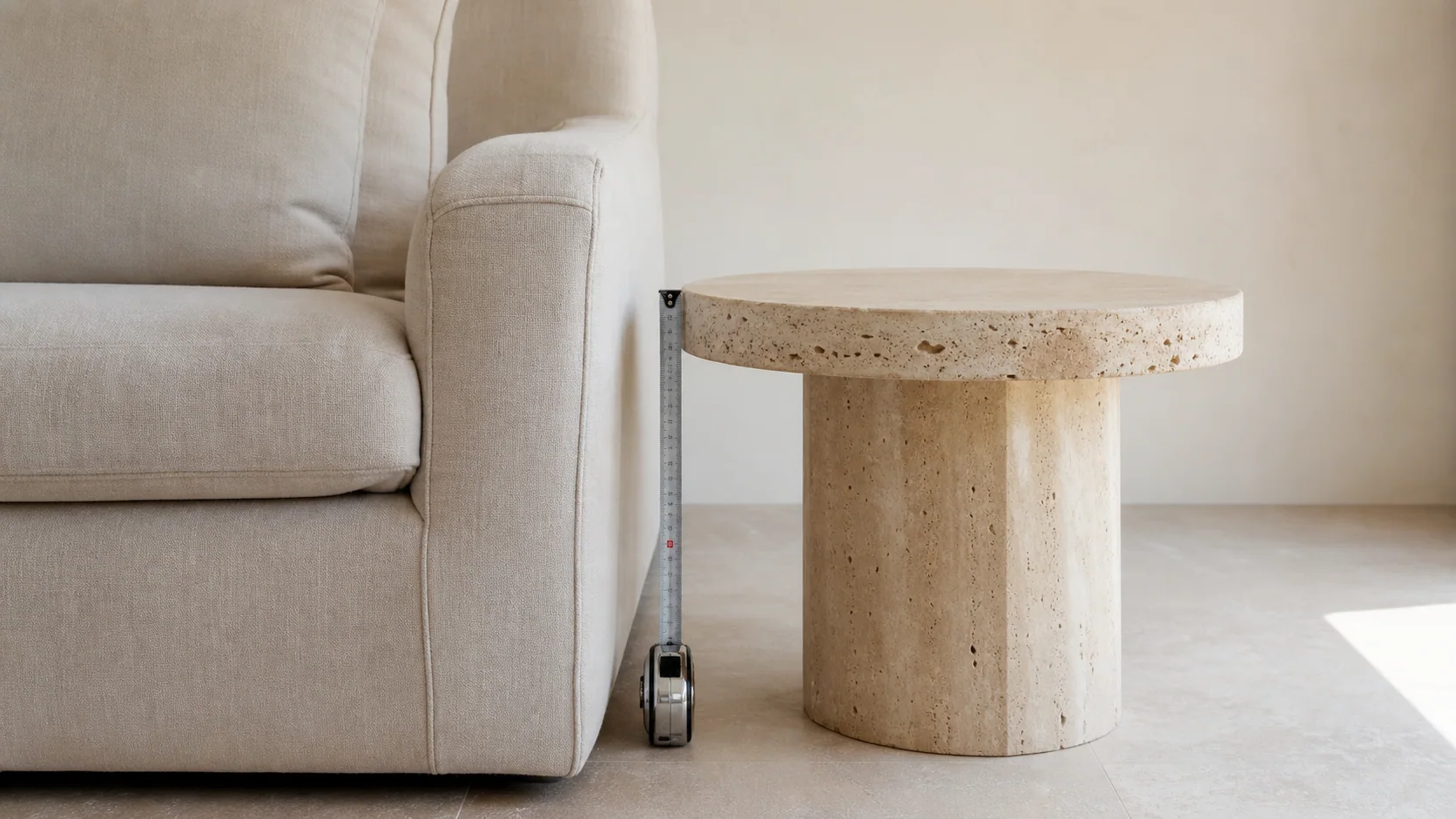
Learn how to choose the right marble side table for a sofa, armchair or bedside setting. Compare ideal height, dimensions, stone types, construction, placement and styling before ordering a natural stone side table.
A marble side table may be smaller than a dining table or coffee table, but its proportions can have a significant impact on how a room looks and functions. When the height, width or placement is wrong, the table can feel disconnected from the surrounding furniture. When the dimensions are carefully selected, it becomes a practical surface and a sculptural natural stone object.
The right side table should relate to the height of the sofa or armchair, provide enough surface area for everyday use and leave sufficient space for comfortable circulation. The stone, construction and shape should also complement the visual weight of the surrounding furniture.
Whether you are searching for a marble side table, a travertine end table, a Beistelltisch aus Marmor or a table d’appoint en marbre, this guide explains the most important details to consider before ordering.
What Is the Difference Between a Side Table and an End Table?
The terms side table and end table are often used interchangeably. Both generally describe a compact table positioned beside a sofa, armchair or lounge chair.
An end table is usually placed at the end of a sofa and is selected primarily for practical use. A side table is a broader category and may also be used beside an armchair, between two seats, in an entrance area or as a decorative pedestal.
In European interiors, the same type of product may also be described as an occasional table, accent table, pedestal table or small natural stone table.
The correct label is less important than the relationship between the table and the furniture around it.
How High Should a Side Table Be?
A side table should generally sit close to the height of the sofa or armchair beside it. This allows the surface to be reached comfortably without requiring the user to bend too far or lift an object above the armrest.
As a practical guideline, the tabletop can be:
- Approximately level with the arm of the sofa
- Slightly below the armrest
- Close to the seat height when used beside a low lounge chair
Many side tables fall between approximately 45 and 60 cm in height. However, the correct measurement depends on the furniture beside which the table will be used.
Before ordering, measure the sofa or chair from the floor to the top of the armrest. The ideal side table will normally sit within a few centimetres of this height.
For Low Sofas and Lounge Chairs
Low-profile sofas often work best with side tables between approximately 40 and 50 cm high. A very tall table beside a low sofa may feel visually disconnected and can be uncomfortable to use.
For Standard Sofas
For many standard sofas, a side table around 50–55 cm high creates a comfortable relationship with the armrest and seating position.
For High-Arm Sofas
Sofas with substantial or raised armrests may require a table closer to 55–60 cm high. The table should still remain visually balanced rather than appearing narrow and excessively tall.
What Is the Ideal Side Table Width?
The ideal width depends on how the table will be used. A compact side table may only need to hold a glass, book or small lamp. A larger table may need space for decorative objects, lighting and everyday accessories.
Common side table widths generally range from approximately 35 to 55 cm.
- 35–40 cm: Suitable for compact rooms and narrow spaces
- 40–45 cm: A versatile size for most sofas and armchairs
- 45–55 cm: Suitable for larger rooms, lamps and decorative styling
A natural stone side table should not be made unnecessarily large. Marble and travertine have strong visual and physical weight, so even a compact piece can have substantial presence.
How Much Space Should Be Left Around a Side Table?
A side table should be close enough to reach comfortably but should not restrict movement around the seating area.
When placing the table:
- Leave a small, comfortable gap between the table and sofa
- Keep primary walkways unobstructed
- Ensure the tabletop does not project significantly beyond the sofa arm
- Check that the table does not block reclining mechanisms or doors
- Allow sufficient clearance for curtains and floor-length fabrics
In compact rooms, a round or softly curved table can improve circulation by removing sharp corners. In larger interiors, a rectangular or sculptural table can create a stronger architectural composition.
Round, Square or Sculptural Side Table?
The shape of the side table influences both circulation and visual balance.
Round Side Tables
A round marble side table creates a softer silhouette and works well beside curved sofas, lounge chairs and compact seating arrangements. The absence of corners can make movement easier in smaller rooms.
Round forms also allow dramatic natural veining to flow across the surface without being restricted by strong linear edges.
Square Side Tables
A square side table creates a clean and structured appearance. It complements linear sofas, contemporary architecture and interiors with strong geometric elements.
Square designs can provide slightly more usable surface area than a round table of a similar overall width.
Rectangular Side Tables
A narrow rectangular side table can be useful where space is limited beside a sofa. It may also work between two lounge chairs or against a wall as a compact decorative surface.
Sculptural Side Tables
Sculptural natural stone tables use the material as a design feature rather than treating it only as a flat surface. Curved bases, contrasting stone combinations and asymmetrical forms can turn a small table into the focal point of a seating area.
Because the piece has a stronger visual identity, the surrounding styling should remain relatively controlled.
Which Natural Stone Is Best for a Side Table?
The right stone depends on the colour palette, lighting and overall character of the room. A small side table can be an opportunity to introduce a more expressive material without overwhelming the interior.
You can compare available options in the DLA Stone material library.
Calacatta Viola
Calacatta Viola is a strong choice for a luxury side table intended to function as a statement piece. Its warm white background and burgundy, violet and grey movement can introduce colour and contrast into a neutral room.
Because side tables have a smaller surface area than dining tables, the selected section of stone becomes especially important. A bold vein may dominate the entire tabletop and give the piece a distinctive identity.
Light Travertine
Light travertine offers a warm, quiet and architectural appearance. Its beige and ivory tones work naturally with linen, bouclé, oak, walnut and neutral upholstery.
A light travertine side table is particularly suitable for Mediterranean, Japandi, minimalist and organic-modern interiors.
Silver Travertine
Silver travertine combines cooler grey and taupe tones with natural linear movement. It works well in contemporary interiors that use smoked glass, dark wood, anthracite metal or grey upholstery.
Nero Marquina
Nero Marquina creates a strong graphic contrast with its black background and white veining. A compact black marble side table can anchor a pale interior and complement dark lighting, metal or architectural details.
Rosso Levanto
Rosso Levanto offers a deep burgundy appearance with contrasting mineral movement. It is particularly effective as an accent piece in interiors with warm wood, cream upholstery or bronze elements.
Dark Emperador
Dark Emperador introduces rich brown tones and works well in layered interiors featuring walnut, leather and warm ambient lighting.
Can a Side Table Combine Two Different Stones?
Yes. Combining two natural stones can create greater depth and make a compact table feel more sculptural.
For example, a calm travertine body can be paired with a more expressive Calacatta Viola surface or detail. This allows the piece to balance architectural warmth with dramatic veining.
When combining materials, the stones should be selected according to:
- Background colour
- Vein direction
- Contrast level
- Surface finish
- Thickness and edge treatment
- The proportion of each material in the design
The combination should feel intentional rather than decorative. One stone should normally act as the dominant material while the second provides contrast or emphasis.
Can a Marble Side Table Also Be Used as a Nightstand?
Some side tables can also function as bedside tables, but the correct height and usable surface area must be considered.
A bedside table should generally sit close to the height of the top of the mattress. This makes it easier to reach a lamp, phone, book or glass of water while in bed.
Before using a side table as a nightstand, check:
- The height of the mattress
- The width of the available bedside space
- Whether a lamp will be placed on the table
- Whether storage is required
- The location of electrical sockets
- The weight and accessibility of the product
A sculptural stone side table works best as a nightstand when open storage is not essential. Customers who require drawers or enclosed storage may need a dedicated bedside unit instead.
Should a Side Table Be Solid Stone or Stone-Clad?
Construction depends on the design, dimensions, stability requirements and intended weight.
Some compact tables may be produced using solid natural stone sections. Other designs use an engineered internal structure clad in genuine marble or travertine.
Solid-stone construction can create a monolithic and substantial object, but the finished piece may be extremely heavy.
Engineered stone-clad construction can preserve the authentic surface and appearance of natural stone while reducing unnecessary weight and supporting more complex forms.
Neither method should automatically be viewed as superior. The appropriate method is the one that provides the required appearance, stability and technical performance for the design.
At DLA Stone, the construction method varies according to the individual product.
Honed or Polished Finish?
The finish changes how the stone responds to light and how strongly its colour and veining appear.
Honed stone has a smooth, low-sheen appearance. It creates a softer, more contemporary effect and usually works well in understated interiors.
Polished stone reflects more light and intensifies the colour and movement of the material. It may be suitable for dramatic marbles and more formal interiors.
For a detailed comparison, read the guide to honed and polished natural stone finishes.
How Should a Marble Side Table Be Styled?
A natural stone side table already has a strong material identity, so the surface does not need to be overcrowded.
Suitable objects may include:
- A compact table lamp
- A small ceramic or glass vase
- One or two books
- A sculptural bowl
- A candle
- A small decorative object
Leave part of the stone visible. Covering the entire surface with accessories reduces the impact of the natural veining and makes the table less practical.
Beside a Neutral Sofa
A Calacatta Viola, Rosso Levanto or Nero Marquina side table can introduce a controlled point of contrast beside beige, cream or grey upholstery.
Beside a Statement Sofa
If the sofa already has a strong colour, pattern or sculptural form, a quieter light travertine or Emperador table may create better balance.
Between Two Armchairs
A central side table between two armchairs should be accessible from both seats. A round or square piece generally works well in this arrangement.
How Long Does a Made-to-Order Side Table Take?
DLA Stone furniture is made to order in its Turkish atelier. Standard production generally takes approximately 4–8 weeks, depending on the product, material, dimensions and workshop schedule.
The production process may include:
- Confirmation of the selected size, stone and finish
- Review of available material photographs
- Technical assessment of the design
- Stone cutting and structural preparation
- Assembly and surface finishing
- Quality control
- Protective crating for transport
Customers receive photographs of the selected natural stone before production. These images confirm the general colour and character of the material but do not serve as a guaranteed digital vein-placement mock-up.
How Is a Natural Stone Side Table Delivered?
Although side tables are smaller than dining tables, natural stone products can still be exceptionally heavy and require specialist handling.
DLA Stone furniture is packed in protective ISPM-15 compliant wooden crates. Eligible shipments are insured for up to 110% of the purchase value.
Complimentary DDP kerbside delivery is available to the European Union, United Kingdom, Switzerland, Norway and Türkiye according to the confirmed order and destination terms.
Kerbside delivery does not include:
- White-glove service
- Indoor carrying
- Unpacking
- Assembly
- Installation
- Removal of the crate
Review the complete international shipping and delivery policy before ordering.
How Should a Marble Side Table Be Maintained?
Marble and travertine are durable natural materials, but they should be used and cleaned with care.
- Use coasters beneath drinks
- Wipe spills promptly
- Clean using a soft cloth
- Choose a pH-neutral stone cleaner
- Avoid vinegar, lemon and acidic products
- Do not use abrasive pads
- Avoid dragging lamps or decorative objects across the surface
- Use professional help when moving a heavy stone table
More detailed instructions are available in the DLA Stone product care guide.
Discover the Wave Travertine & Calacatta Viola Side Table
The Wave Travertine & Calacatta Viola Side Table combines the calm architectural character of travertine with the expressive burgundy and violet movement of Calacatta Viola.
The contrasting materials allow the piece to function as both a practical side table and a sculptural accent. It can be positioned beside a sofa, next to a lounge chair or used as a statement bedside table where open storage is not required.
Explore the Wave Travertine & Calacatta Viola Side Table.
Ordering a Custom Side Table
Private clients can select an available DLA Stone design or request an assessment for different dimensions, stone options or finishes.
To request a non-standard piece, provide:
- Required height, width and depth
- The height of the sofa, chair or mattress
- Preferred stone or colour family
- Desired finish
- Delivery country and postcode
- Reference photographs where available
Submit your requirements through the DLA Stone bespoke service.
Side Tables for Interior Designers and Commercial Projects
Side tables are frequently specified in pairs or larger quantities for hotels, restaurants, residences, lounges and hospitality projects.
Interior designers, architects, developers and eligible trade professionals can apply to the DLA Stone Trade Program for project support, bespoke production and applicable commercial terms.
Frequently Asked Questions
Should a side table be higher than the sofa arm?
A side table should normally sit close to the height of the sofa arm or slightly below it. A table that is significantly higher may feel uncomfortable and visually unbalanced.
What is the standard height of a marble side table?
Many side tables are approximately 45–60 cm high. The correct height depends on the sofa, armchair or mattress beside which the table will be used.
Can a marble side table be used as a bedside table?
Yes, provided its height is close to the top of the mattress and the surface is large enough for the intended objects. It is most suitable where drawers or enclosed storage are not required.
Is a marble side table too heavy to move?
Natural stone furniture can be considerably heavier than timber or metal furniture. The exact weight depends on the dimensions and whether the piece is solid stone or uses an engineered stone-clad structure.
Can I order two matching side tables?
Yes. Matching pieces can be requested, although natural stone patterns will not be completely identical. Material can be selected to create a visually coordinated pair.
Can I choose a custom stone combination?
Custom material combinations can be assessed according to stone availability, technical compatibility and the design of the product.
How long does production take?
Standard production generally takes 4–8 weeks. The final schedule depends on the selected product, stone, dimensions and workshop capacity.
Does delivery include carrying the table indoors?
No. Standard delivery is kerbside and does not include indoor carrying, unpacking, assembly or installation.
Choose a Side Table That Fits the Space
The right marble side table should balance practical use with material character. Height determines comfort, width determines functionality and the selected stone defines the visual impact of the finished piece.
Rather than selecting a table only because it looks attractive in a photograph, compare its dimensions with the sofa, armchair or bed beside which it will be placed. Then consider the shape, construction, surface finish and natural stone variation.
Explore the DLA Stone collection, review available options in the material library or request a custom natural stone side table.