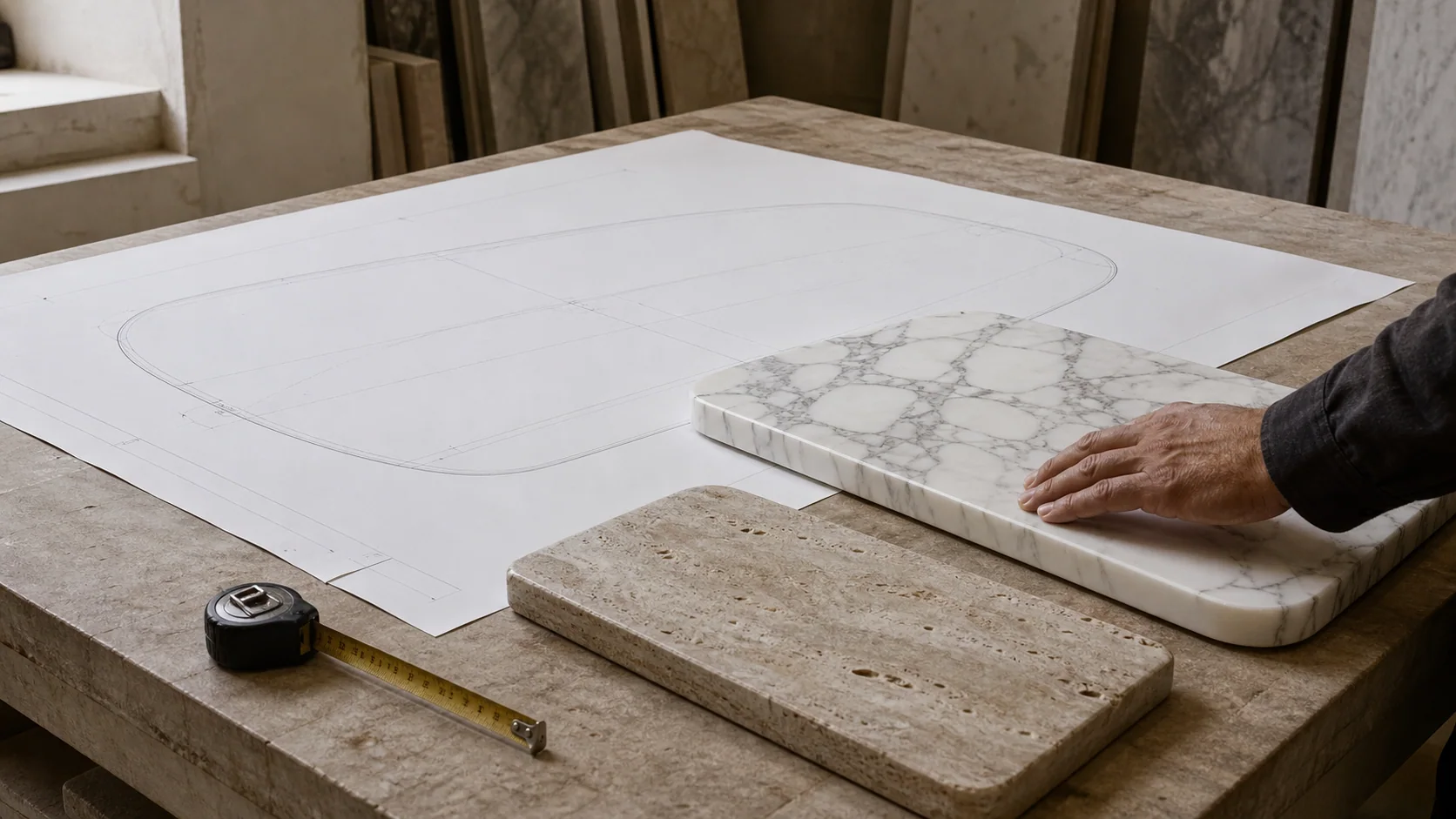
A complete guide to choosing a custom marble dining table, from dimensions and stone selection to construction, finishes, natural veining and international delivery. Discover how DLA Stone creates made-to-order natural stone furniture for private interiors, designers, architects and commercial projects.
A custom marble dining table is more than a functional piece of furniture. It becomes the visual centre of the room, defining how the surrounding materials, lighting and proportions are experienced. Unlike mass-produced furniture, a made-to-order natural stone table can be selected according to the dimensions of the space, the preferred stone, the surface finish and the architectural character of the interior.
Across European markets, the same type of product may be described as a Marmortisch nach Maß, a table à manger en marbre sur mesure, a tavolo da pranzo in marmo su misura or a marmeren eettafel op maat. Regardless of terminology, the essential decisions remain the same: proportion, material, construction, finish and delivery.
This guide explains what to consider before ordering a bespoke marble or natural stone dining table from DLA Stone.
Why Choose a Custom Marble Dining Table?
Standard dining tables are designed around fixed dimensions and a limited range of materials. A custom dining table allows the design to respond directly to the room rather than forcing the room to adapt to the furniture.
A made-to-order table can offer:
- Dimensions selected for the available space and seating capacity
- A choice of marble, travertine and other natural stones
- Rectangular, round, oval or sculptural forms
- Honed or polished surface finishes
- Different edge profiles and corner treatments
- Solid-stone or engineered stone-clad construction, depending on the design
- Greater control over the visual balance of the finished piece
Customisation is particularly valuable in open-plan homes, high-end apartments, villas, hospitality spaces and projects where furniture must align with an established architectural concept.
Start with the Space, Not Only the Stone
One of the most common mistakes when choosing a luxury dining table is selecting the material before confirming the correct scale. Even an exceptional marble can feel visually heavy or impractical when the table is too large for the room.
Before choosing a design, measure:
- The full length and width of the dining area
- The distance between the table and surrounding walls
- The clearance required behind dining chairs
- The position of doors, windows and circulation routes
- The size and location of pendant lighting
- The number of seats required for everyday and occasional use
As a general planning principle, approximately 90 cm of clearance around the table provides comfortable circulation. Larger rooms may benefit from 100–120 cm, particularly where chairs must remain usable while another person passes behind them.
Rectangular Dining Tables
Rectangular marble dining tables work well in long rooms, open-plan living spaces and interiors where the table needs to align with architectural lines. They are also practical for seating larger groups and can accommodate a wide variety of base designs.
A rectangular table creates a formal, structured composition. It is particularly effective with dramatic stones such as Calacatta Viola, Nero Marquina or Rosso Levanto, where the long tabletop allows the natural veining to develop across a broad surface.
Round Dining Tables
A round natural stone dining table encourages conversation and creates a softer visual flow. It can be especially effective in square rooms, compact dining areas and interiors with curved architectural elements.
Round tables also eliminate sharp corners, but the base design must be carefully engineered to ensure stability and comfortable legroom. A central pedestal can provide a more flexible seating arrangement than multiple legs positioned around the perimeter.
Oval and Sculptural Tables
Oval tables combine the seating capacity of a rectangular table with the softer circulation of a round design. They are well suited to contemporary interiors and can visually reduce the weight of a large stone surface.
Sculptural dining tables may feature rounded corners, monolithic bases, fluted details or asymmetrical forms. These pieces require close coordination between design, material thickness, structural support and stone fabrication.
Choosing the Right Natural Stone
Every natural stone has its own colour, mineral structure, veining and level of variation. The right choice should complement the interior while also matching the way the table will be used.
You can compare current marble and travertine options through the DLA Stone material library.
Calacatta Viola
Calacatta Viola is known for its warm white background and expressive burgundy, violet and grey veining. It is a strong choice for interiors where the dining table is intended to function as a statement piece.
Because of its distinctive pattern, Calacatta Viola works particularly well in restrained interiors with neutral walls, natural wood, brushed metals or minimal decorative elements. The stone already provides substantial visual movement, so the surrounding design does not need to compete with it.
Travertine
Travertine creates a warmer and more architectural appearance. Light travertine suits soft neutral interiors, while silver travertine introduces cooler grey and taupe movement.
A travertine dining table is often selected for Mediterranean, minimalist, organic-modern and contemporary interiors. Its linear structure creates a calmer visual effect than highly veined marble.
Nero Marquina
Nero Marquina is a deep black marble with contrasting white veining. It creates a graphic and sophisticated result, particularly in modern interiors with controlled lighting and strong tonal contrast.
Dark marble can appear visually heavier than light stone, so the proportions of the tabletop and base should be carefully considered. Rounded corners, refined edge details or a lighter surrounding palette can help balance the composition.
Rosso Levanto and Dark Emperador
Rosso Levanto introduces deep burgundy and wine tones, while Dark Emperador offers a rich brown base with lighter mineral veining. Both materials work well in interiors that use dark wood, bronze, leather and warmer lighting.
These stones create a more intimate and layered atmosphere than white marble and can be particularly effective in dining rooms, boutique hospitality spaces and private members’ environments.
Solid Stone or Stone-Clad Construction?
Not every natural stone table should be produced using the same construction method. At DLA Stone, the appropriate structure depends on the design, dimensions, material, weight and intended visual effect.
Some pieces may be produced from solid natural stone sections. Others use an engineered internal structure that is carefully clad in genuine marble or travertine. Both methods use real natural stone, but they serve different design and logistical requirements.
Solid-stone construction may be appropriate for smaller elements, monolithic forms and designs where the weight can be safely supported and transported.
Engineered stone-clad construction can reduce excessive weight while preserving the appearance, texture and edge continuity of natural stone. It is especially useful for larger tabletops, substantial pedestal forms and pieces intended for international delivery.
The selected construction method should never be treated as a shortcut. It must be engineered according to the proportions of the piece and fabricated so that joints, corners and vein transitions remain visually controlled.
Honed vs Polished Marble
The surface finish changes how the stone looks, feels and responds to light.
Honed marble has a smooth, low-sheen surface. It produces a softer and more contemporary appearance, reduces reflections and allows the natural colour of the stone to feel more understated.
Polished marble has a reflective surface that intensifies colour, contrast and veining. It can create a more formal and luxurious appearance, especially in spaces with controlled architectural lighting.
Neither finish is universally better. The right choice depends on the stone, the interior concept and the desired level of reflection. For a more detailed comparison, read the DLA Stone guide to honed and polished marble finishes.
Understanding Natural Veining and Variation
Natural stone is not a printed or standardised material. Every slab contains unique variations in colour, mineral deposits, veins, pores and movement. These differences are not defects; they are part of what makes each finished table individual.
Before production begins, DLA Stone provides images of the selected stone so the customer can review the general colour, pattern and character of the available material.
These images are provided for material approval rather than as a guaranteed digital vein-placement mock-up. During fabrication, the workshop positions and cuts the stone according to the dimensions, structural requirements and visual balance of the piece. Exact vein placement can therefore vary from reference images.
Customers who prefer a quieter result should select a more uniform stone or request slabs with reduced pattern variation. Customers seeking a statement piece may prefer bolder veining, stronger contrast and more expressive mineral movement.
How Large Should a Marble Dining Table Be?
The ideal size depends on the number of seats, chair width, table shape and room dimensions. A dining table should provide sufficient space for each person without making the room feel congested.
As a general reference:
- Four-person rectangular tables often begin around 120–140 cm in length
- Six-person tables commonly range from approximately 160–180 cm
- Eight-person tables generally begin around 200–220 cm
- Larger ten-person designs may require 240 cm or more
- Round four-person tables are often approximately 100–120 cm in diameter
- Round six-person tables commonly require approximately 130–150 cm
These figures are guidance rather than fixed rules. Wide dining chairs, armchairs, sculptural bases and generous place settings can increase the required tabletop dimensions.
Base Design, Stability and Legroom
The base is not only a visual feature. It determines the table’s stability, structural performance and seating comfort.
A central pedestal can provide more freedom when positioning chairs, while two separate bases can distribute the weight of a long rectangular top. Four-leg designs may create a lighter appearance but require careful placement to avoid restricting legroom.
For heavy natural stone furniture, the relationship between the tabletop and the base must be calculated carefully. A visually narrow base may not provide adequate support for an oversized stone surface, while an unnecessarily large base can make the table difficult to use.
DLA Stone evaluates the overall dimensions, stone selection and structural requirements before confirming whether a requested design is technically suitable.
Production Time for a Custom Dining Table
DLA Stone pieces are made to order rather than taken from mass-produced inventory. Standard production generally takes approximately 4–8 weeks, depending on the material, dimensions, complexity and current workshop schedule.
The process typically includes:
- Confirmation of dimensions and selected stone
- Review of available material images
- Technical assessment of the design
- Stone cutting and structural preparation
- Assembly, finishing and quality control
- Protective packing and preparation for international transport
Highly complex, oversized or materially specific projects may require additional production time. The estimated schedule is confirmed before manufacturing begins.
International Delivery, Crating and Insurance
Natural stone furniture requires specialist packing and transport. Standard parcel packaging is not sufficient for heavy, high-value marble and travertine pieces.
DLA Stone furniture is packed in protective ISPM-15 compliant wooden crates suitable for international transport. Eligible shipments are insured for up to 110% of the purchase value.
DLA Stone offers complimentary DDP kerbside delivery to the European Union, United Kingdom, Switzerland, Norway and Türkiye. DDP delivery means the applicable international transport, customs processes, duties and taxes are included according to the confirmed order destination.
Standard delivery is kerbside. It does not include white-glove service, indoor carrying, unpacking, assembly or installation. Because natural stone pieces can be extremely heavy, customers should arrange suitable professional assistance before the delivery date.
Full destination and delivery conditions can be reviewed in the DLA Stone shipping and delivery policy.
Ordering as a Private Client
Private clients can select a current DLA Stone design or request a custom version in a different size, stone or finish. Depending on the product, certain designs can be adapted while preserving the original proportions and structural logic.
When requesting a custom dining table, provide:
- Preferred dimensions
- Required seating capacity
- Preferred stone or colour family
- Desired surface finish
- Delivery country and postcode
- Reference images or architectural drawings, where available
To begin a custom order, visit the DLA Stone bespoke service or contact the DLA Stone team.
Ordering as an Interior Designer, Architect or Trade Professional
Design professionals often require more than a standard product purchase. Projects may involve custom dimensions, material coordination, quantity planning, commercial timelines and multiple pieces produced within the same stone family.
The DLA Stone Trade Program is designed for interior designers, architects, property developers, hospitality studios and other eligible industry professionals. Trade enquiries can include bespoke production, project support, material selection and preferential commercial terms.
Providing drawings, room dimensions, mood boards and expected quantities at the beginning of the enquiry allows the DLA Stone team to evaluate feasibility more efficiently.
Caring for a Marble Dining Table
Marble and travertine are durable natural materials, but they should be treated with appropriate care.
- Clean the surface using a soft cloth and pH-neutral product
- Wipe spills promptly, particularly acidic liquids
- Avoid lemon, vinegar and harsh chemical cleaners
- Use coasters, placemats and trivets during everyday use
- Do not drag heavy or sharp objects across the surface
- Use professional assistance when moving the table
Detailed maintenance guidance is available in the DLA Stone product care guide.
Frequently Asked Questions
Is every DLA Stone dining table made from solid marble?
No. Construction varies according to the product, dimensions and structural requirements. Some pieces may use solid natural stone, while others use an engineered internal structure clad in genuine marble or travertine. The construction method is confirmed according to the selected design.
Can I select the exact marble slab?
DLA Stone provides images of the available stone before production so you can review the overall colour and pattern. These images are intended for material approval. Exact vein placement cannot be guaranteed through a digital mock-up because the final layout depends on cutting, dimensions and technical fabrication requirements.
How long does a custom marble dining table take to produce?
Standard production generally takes 4–8 weeks. Complex designs, oversized tables and limited stone availability may extend the schedule.
Is international delivery included?
Complimentary DDP kerbside delivery is available for eligible orders to the European Union, United Kingdom, Switzerland, Norway and Türkiye. The applicable shipping, customs duties and taxes are included according to the confirmed destination and order terms.
Does delivery include carrying the table inside?
No. Standard delivery is kerbside and does not include white-glove service, indoor carrying, unpacking, assembly or installation. Professional handling should be arranged in advance because natural stone furniture can be exceptionally heavy.
Can designers and architects order custom project pieces?
Yes. Interior designers, architects, hospitality professionals and property developers can apply for the DLA Stone Trade Program for project support, bespoke production and eligible commercial terms.
Can I order a marble dining table in a custom size?
Yes. Many designs can be adapted to suit different spaces and seating requirements. Feasibility depends on the selected dimensions, stone, base structure and overall weight. Submit your requirements through the bespoke enquiry page for evaluation.
Commission Your DLA Stone Dining Table
The most successful natural stone dining tables balance visual impact with proportion, stability and everyday usability. Choosing the right stone is important, but the final result also depends on construction, finish, dimensions, packing and delivery planning.
Explore the DLA Stone collection, request a custom natural stone dining table or apply to the Trade Program for professional and commercial projects.