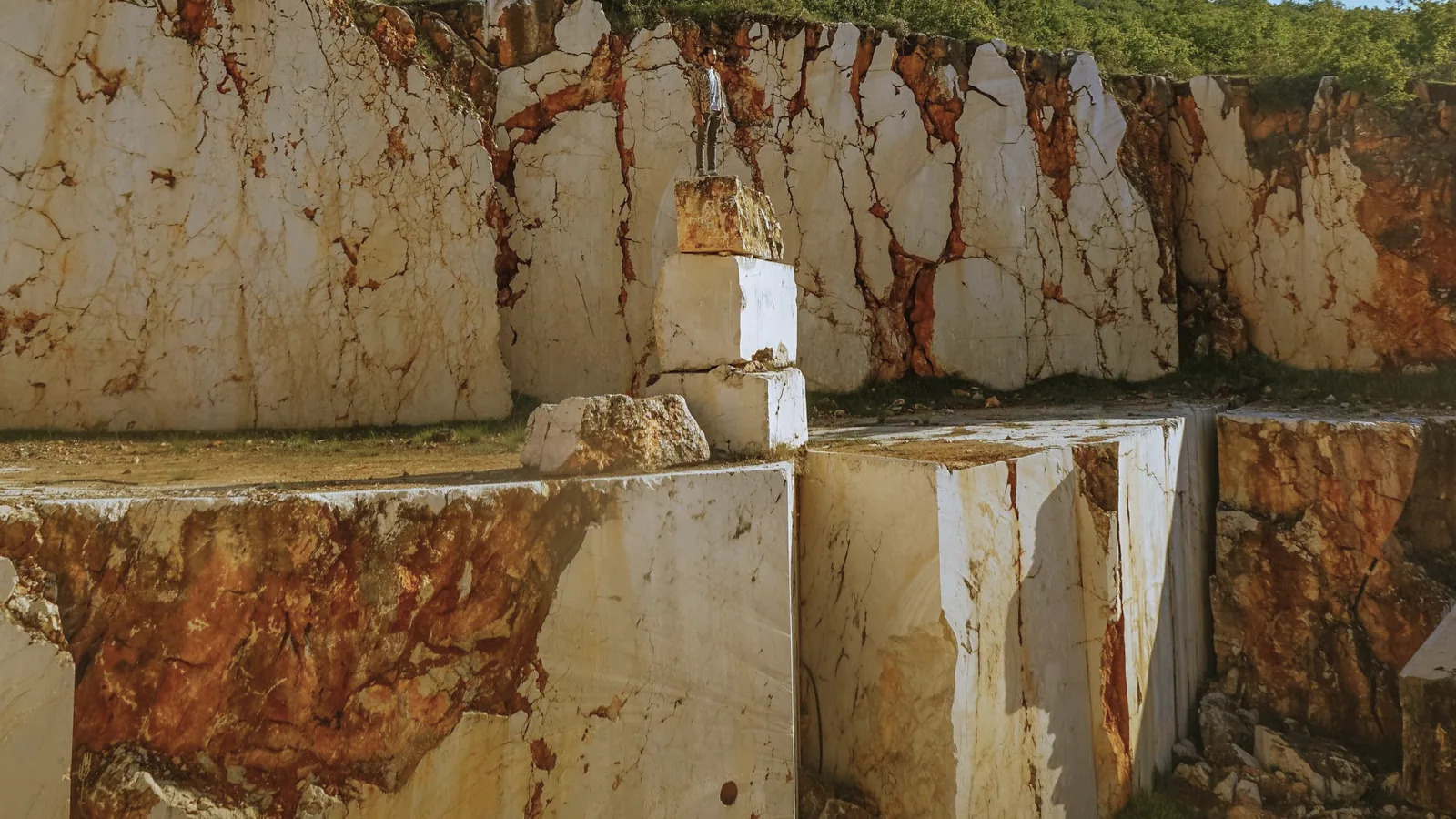
Anatolia sits on a collision of continents, which is why its mountains hold an unusual concentration of marble and travertine — and why Pamukkale is travertine still forming.
Anatolia sits on a collision. For tens of millions of years continental plates have been pushing into each other here, folding and heating the limestone caught between them. That process is what turns limestone into marble, and it is why the mountains of this country hold an unusual concentration of it.
The stone in a table made here did not travel far to become furniture. Understanding where it came from explains a good deal about what it is.
What Is Pamukkale, and Why Does It Matter?
In the south-west of the country there is a hillside of white terraces called Pamukkale — "cotton castle". It is a UNESCO World Heritage site, and millions of people visit it every year without realising what they are standing on.
They are standing on travertine, still forming. Mineral-rich water rises from the ground, cools, and leaves calcium carbonate behind, layer over layer, year after year. Given enough time and pressure beneath the surface, that is precisely how the travertine in a finished table came to exist.
It is worth knowing when you run a hand across a travertine surface. The small voids in it are the spaces where gas escaped while water was laying the stone down. The texture is not a flaw in the material. It is the record of how it was made.
Which Stones Come From Here?
More than most people expect, and within remarkably short distances of one another:
- Travertine in creams, silvers, walnut browns and pale golds
- White and light marbles, many from the Afyon region
- Dark and dramatic marbles — deep reds, browns and blacks with strong veining
- Onyx, translucent, in honeys and greens
This range is why a single workshop can offer one piece in six genuinely different stones without importing any of them. The variety is local.
How Long Has Stone Been Cut Here?
Since antiquity. The English word "marble" descends from the Greek marmaros, and the Sea of Marmara — with its quarry island — takes its name from the stone taken out of it. Roman builders shipped Anatolian stone across the empire.
What has changed is not the quarrying but the route. A workshop here can now finish a piece and send it directly to a home in Rotterdam or Munich, without the chain of traders that used to sit in between.
Why Does Travertine Suit Furniture So Well?
Travertine has three qualities that furniture asks for.
It is warm. Its palette lives in creams, honeys and soft browns, which settle beside oak, linen, wool and brass instead of competing with them.
It is forgiving. Its natural variation absorbs the marks daily life produces — a ring, a scuff, a fingerprint — where a pale, high-contrast stone displays each one.
It is tactile. Even filled and honed, the surface keeps a faint texture that reads as material rather than as product. This is the quality photographs consistently flatten, and the reason people who dismissed travertine on a screen frequently choose it in a room.
Our guide on travertine coffee tables looks at how that plays out in a living room specifically.
Is Travertine a Lesser Version of Marble?
No — it is a different stone with different strengths. Travertine formed at the surface, deposited by water; marble formed under pressure, deep down. One is textured and warm and forgiving, the other is dense and dramatic and precise.
Many rooms are better served by travertine. It is not a compromise on the way to something else.
What Changes When the Workshop Is Near the Quarries?
Three things, practically.
Selection. Blocks can be seen and chosen early, rather than bought from whatever a distributor happens to be holding.
Range. Offering six stones is a matter of choosing between local materials rather than importing five of them.
Directness. The stone goes from block to finished piece to your room, without accumulating a margin at every stop along the way.
How Does a Piece Reach a European Home?
It is made first. Production takes four to six weeks, because the piece is cut and finished for your order rather than pulled off a shelf.
It then travels crated, by road for most of Europe. Delivery is included across the EU, the UK, Norway, Switzerland and Türkiye — the cost sits in the price rather than appearing at checkout, which matters more for a heavy object than for most things you buy.
Our guide on international shipping covers the day itself.
What Should I Ask a Maker?
A few questions separate a workshop from a reseller:
- Do you finish the stone yourselves? Many sellers only assemble and ship.
- Can I see the actual piece before it ships? With natural stone the individual slab matters, so photographs of your piece mean more than catalogue images.
- How is it crated? Heavy stone travels well when packed properly and badly when it is not.
- Does the stone I choose change the price? Worth knowing before you fall for one.
On the last point, our answer is no. A Plinth Coffee Table costs the same in Travertine Light as it does in Calacatta Viola — because you should be choosing the stone you actually want, not the one that fits the budget.
Does Origin Show Up in the Finished Piece?
Not directly. A table is beautiful because of how the block was selected, cut and finished, not because of the postcode it came from.
What being here gives is access — to a wider range of stone, seen earlier, worked by people who have been handling it for a long time. The piece in your room is what was done with that access.